Planum Boreum (North polar cap)
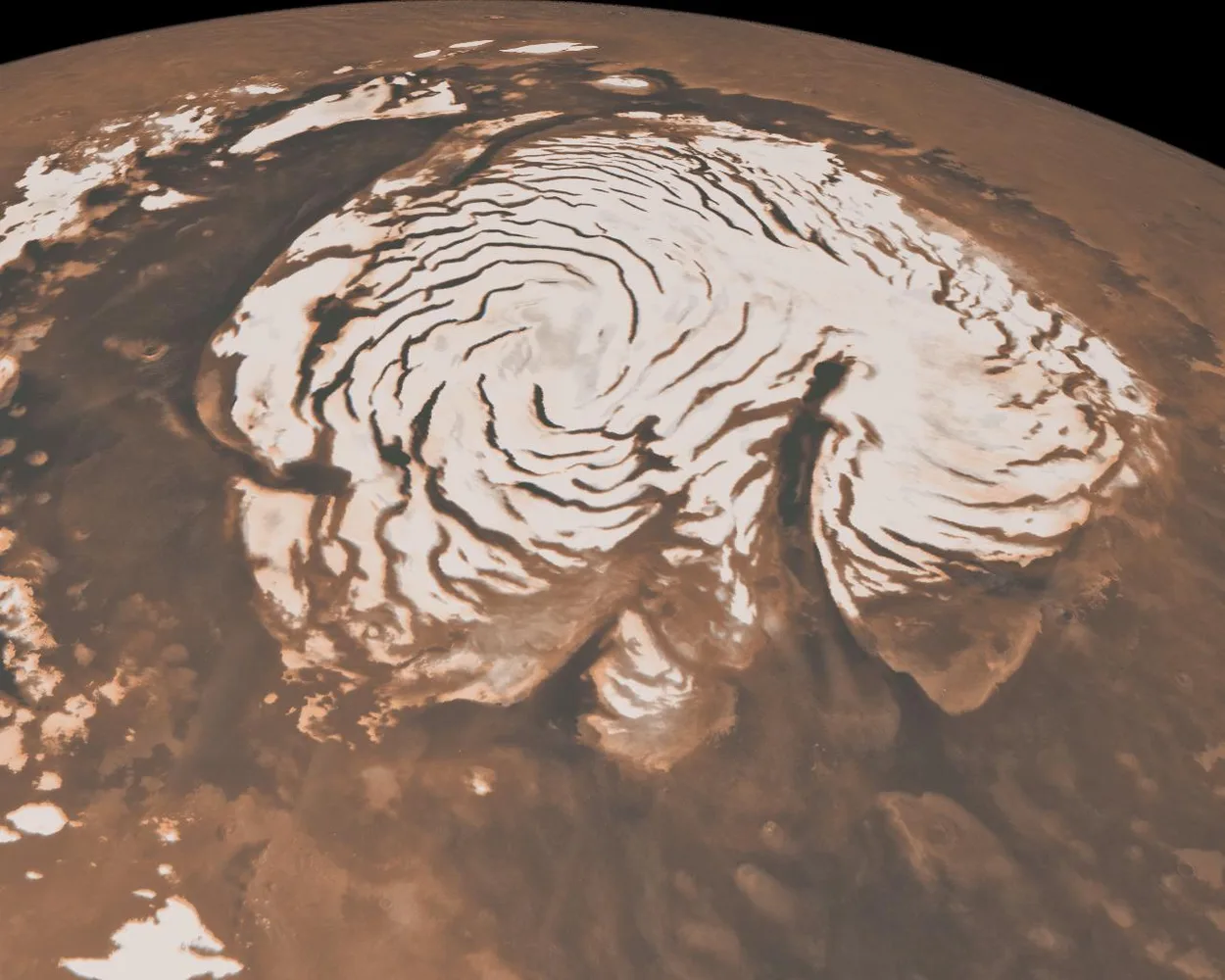
Northern Ice Cap of Mars
Image: NASA/JPL-Caltech/MSSS · PIA13163 · NASA sourceOverview
Planum Boreum, Mars' north polar ice cap, represents one of the largest water reservoirs on the Red Planet. This massive dome-shaped structure extends approximately 1,000 kilometers in diameter and rises up to 3 kilometers above the surrounding terrain, containing enough water ice to cover the entire planet with a 1.5-meter layer if melted.
The ice cap consists of layered deposits that preserve millions of years of Martian climate history, with alternating layers of water ice and dust that record ancient climate cycles. These polar layered deposits make up the majority of the ice cap's volume and offer scientists an unprecedented archive of Mars' atmospheric evolution.
Recent 2024 research has revealed that the ice cap is currently undergoing active retreat through ice block falls and mass wasting, providing new insights into how Mars' water cycle continues to shape the planet's polar regions in the present day.
Quick Facts
Layered Ice Architecture
The north polar ice cap's structure reveals a complex history of climate change on Mars. The layered deposits extend up to 2 kilometers thick and consist of alternating bands of relatively clean water ice and dusty ice layers, each recording different periods of Martian atmospheric conditions.
Seasonal Cap
A thin layer of CO₂ frost that forms each winter and sublimates during summer, driving the planet's seasonal atmospheric pressure changes.
Residual Cap
The permanent water ice core that persists year-round, containing the vast majority of the ice cap's water reserves.
Basal Unit
The foundation layer composed of sand and dust cemented by water ice, forming the base upon which the layered deposits accumulated.
Mars Water Cycle Engine
Seasonal Water Exchange
Each Martian summer, the north polar ice cap releases significant amounts of water vapor into the atmosphere, driving global water transport. This seasonal sublimation creates atmospheric humidity that can travel to other parts of Mars, including the equatorial regions.
The water vapor can condense and precipitate as frost at night or during winter, creating a planet-wide water cycle centered on the polar ice caps.
Climate History Archive
The layered structure preserves evidence of Mars' orbital variations and climate shifts over millions of years. Each layer represents different atmospheric dust concentrations and ice accumulation rates.
Scientists can read these layers like tree rings, revealing periods of dust storms, atmospheric thickness changes, and water availability.
Recent Scientific Breakthroughs
Active Ice Cap Retreat (2024)
Groundbreaking 2024 research published in Nature Communications revealed that the north polar ice cap is actively retreating through ongoing mass wasting processes. Ice block falls are intensive at the marginal steep scarps, causing asymmetric retreat of the ice cap.
This discovery quantifies current water ice loss and provides evidence of basal unit undercutting effects, showing that Mars' climate is still actively reshaping its polar regions.
SHARAD Radar Discoveries
The SHARAD radar sounder aboard Mars Reconnaissance Orbiter has mapped the base of the north polar cap 1.5-2 km beneath the surface, revealing the true extent of water ice reserves and internal structure.
These observations confirmed that the ice cap contains approximately 55% water ice by volume, with enough water to cover Mars with a 1.5-meter global ocean if melted.
Spiral Trough Formation
The ice cap's distinctive spiral trough patterns, visible from orbit, are formed by katabatic winds flowing down from the ice cap's center. These troughs expose the internal layered structure and provide natural cross-sections for studying the ice cap's composition and history.
Recent analysis suggests these troughs are actively maintained by wind erosion and sublimation processes, making them dynamic features that continue to evolve under current Martian conditions.
Terraforming Assessment
Exceptional Terraforming Potential
Massive water reserves and climate regulation capabilities
Advantages
- • Largest accessible water reservoir on Mars
- • Natural climate regulation through water cycle
- • Existing atmospheric water transport system
- • Layered structure ideal for mining operations
- • Evidence of ongoing geological processes
- • Rich climate history for understanding Mars
- • Potential for large-scale water extraction
Challenges
- • Extreme polar temperatures (-150°C to -70°C)
- • Limited solar radiation for energy generation
- • Extreme seasonal day/night cycles
- • Active ice retreat and instability
- • Difficult access and harsh conditions
- • Dust accumulation in equipment
- • Radiation exposure at high latitudes
In-Situ Resource Utilization
Water Extraction Potential
The north polar ice cap represents the most significant water resource for future Mars missions. With relatively pure water ice accessible near the surface through the exposed layers in spiral troughs, extraction operations could provide water for drinking, agriculture, and industrial processes.
Water can also be electrolyzed to produce oxygen for life support and hydrogen for rocket fuel, making the polar ice caps crucial infrastructure for Mars exploration and settlement.
Atmospheric Engineering Implications
Any terraforming efforts on Mars would need to carefully consider the polar ice caps' role in the planet's water cycle. While melting the ice caps could provide atmospheric water vapor, their current function as climate regulators and seasonal water sources makes them valuable in their present state for supporting life across Mars.
Future Exploration Opportunities
The north polar ice cap remains one of the highest priority targets for future Mars exploration. Understanding its structure, dynamics, and accessibility will be crucial for planning sustainable human presence on Mars and unlocking the planet's water resources.
Proposed Mission Objectives
- • Deep ice core drilling for climate history
- • Characterization of spiral trough dynamics
- • Water ice purity and accessibility mapping
- • Long-term monitoring of ice cap retreat
- • Assessment of extraction technologies
Technological Requirements
- • Cold-weather operational capabilities
- • Automated drilling and sampling systems
- • Long-range transportation methods
- • Extended power systems for polar night
- • Advanced radar and imaging technology