155 m
Distance from the Apollo 12 lunar module to Surveyor 3. The Surveyor was still sandblasted: ~103 pits/cm², and that was the edge of the plume. [3]
Population Mars · open hardware R&D
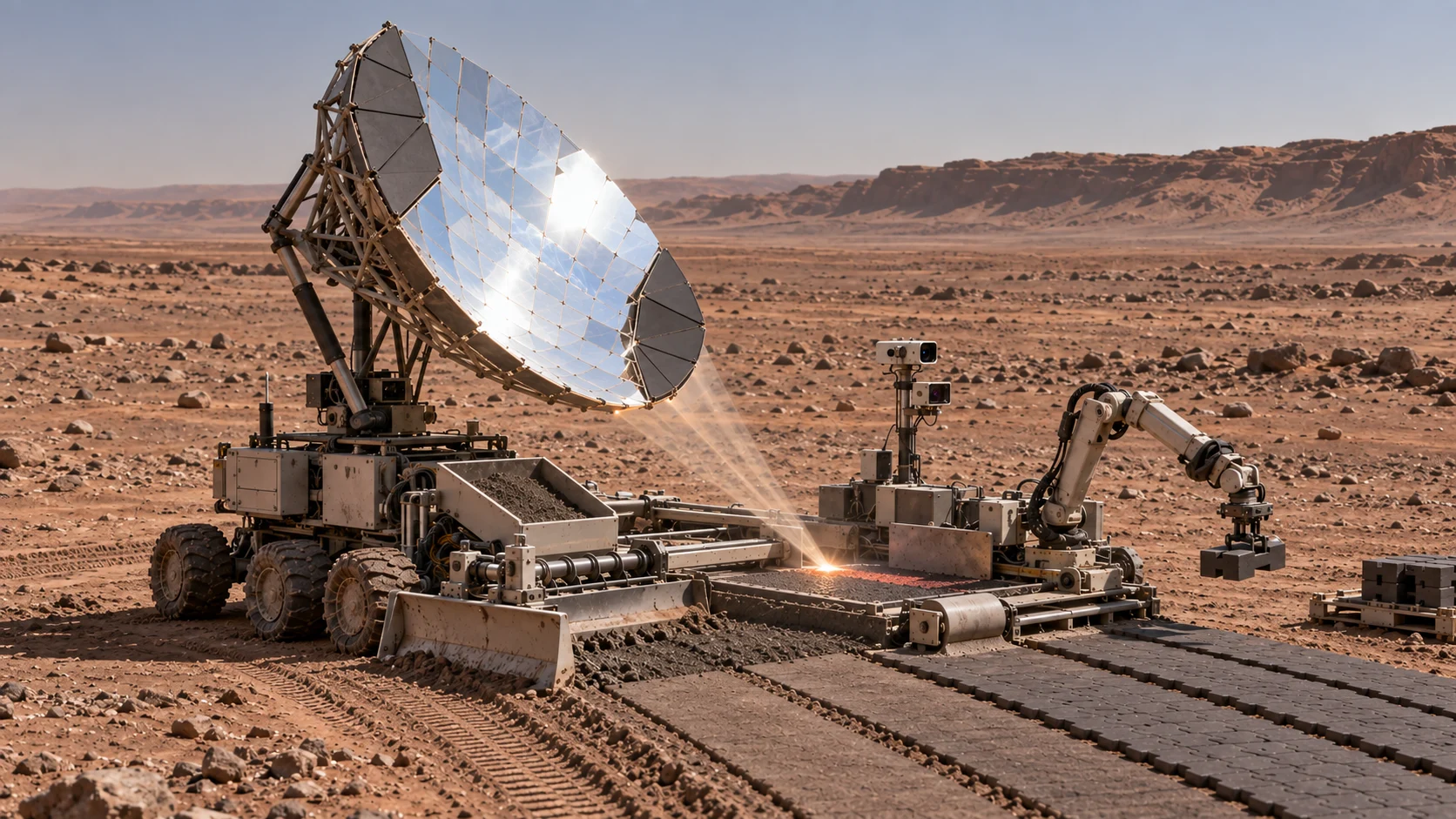
Melt coarse rock with concentrated sunlight, stir in preheated fines, and anneal the mush into a 5 cm crystalline road base: asphalt, made with sunlight, for landing pads and roads on the Moon and Mars.
Stage: V1 hardware in procurement. No test data yet.
01 · The problem
Rocket exhaust hitting loose regolith throws dust and gravel at hundreds of metres per second. There are no pads and no roads on the Moon or Mars, and every future landing, rover route and habitat site needs them.
155 m
Distance from the Apollo 12 lunar module to Surveyor 3. The Surveyor was still sandblasted: ~103 pits/cm², and that was the edge of the plume. [3]
300–2,000 m/s
Estimated speed of regolith ejected by the Apollo 12 descent plume. Lunar escape velocity is ~2,400 m/s. [3]
5–18 cm
Soil eroded under the Phoenix lander on Mars, exposing subsurface ice. Cratering under a human-class Mars lander could threaten the mission. [4]
The baseline
The best published result: a laser standing in for a Fresnel lens melted lunar simulant into interlocking glass tiles.[1][2] It proved the idea. Its limits define our design.
02 · The thesis
Do not melt everything to glass, and do not excavate and sieve aggregate. Melt pools in the coarse rock, stir medium and fine aggregate into the pool, and screed the result: a partially molten crystal mush, the way asphalt is aggregate held in a binder. The process runs across a wider temperature band than full melting, and the product is thicker and rougher.
Melting basalt from ambient takes about 2 MJ/kg in theory (sensible heat plus ~0.4–0.5 MJ/kg latent). In practice, full-melt processes spend several times that, because a 1,400 °C surface radiates ~440 kW/m² into vacuum. We melt only 25–30 % of the placed mass and bring the rest to ~1,000 °C, where radiative loss is a third as large.
σT⁴ at 1,400 °C ≈ 440 kW/m²; at 1,000 °C ≈ 150 kW/m² (ε = 1)
Glass has no crack-arrest mechanism. Unmelted crystalline aggregate deflects and pins cracks. Industrial cast basalt, melted at ~1,280–1,300 °C and cooled slowly in kilns, recrystallizes to pyroxene and reaches 300–450 MPa compressive strength with Mohs hardness 8.
PAVER glass tiles: 94 MPa. Cast basalt: 300–450 MPa.
Filler of the same composition acts as a nucleant. A seeded basaltic mush should crystallize faster and at less undercooling than a clean melt, giving a cast-basalt-like ceramic instead of glass. V1 tests this directly.
Hypothesis under test in V1 (experiment 04).
A regolith dust bed in vacuum conducts about 0.001–0.01 W/m·K. Solid basalt conducts ~1.5–2.5 W/m·K, 100–1,000× more. Flux on cobbles couples deeper than flux on dust. Coarse feed also carries less adsorbed volatile per kg.
Lunar regolith: 0.00074 W/m·K at the surface (Diviner); 0.01–0.03 at depth (Apollo).
Sources: energy [7]; cast basalt [5, 6]; PAVER [1]; conductivity [8, 9].
| ESA PAVER (measured / published) | Solar paving (design) | |
|---|---|---|
| Feed preparation | Fine simulant powder, oven-dried | Coarse rock windrowed in place; fines preheated and degassed on board. No sieving. Target |
| Mass melted | ~100 % | 25–30 %; remainder preheated filler Target |
| Energy per kg placed | ~10–14 MJ/kg of beam energy (our calculation from the lab track parameters) | 3–5 MJ/kg delivered Projection |
| Depth per pass | ~1.8–2 cm | ≥5 cm Target |
| Surface | Glassy, smooth | Grooved by the screed for traction Target |
| Microstructure | Glass on top, dendritic crystals below | Crystalline throughout (seeding + annealing hood) Target |
| Cracking | Cracks when a solid track is re-heated | Cracks directed into joints scored every 0.5–1 m Target |
| Placed volume per m² of collector per sunlit day | 0.003–0.004 m³ (lab parameters) · 0.007 m³ (ESA pad estimate) | 0.0065–0.011 m³ Projection |
13.5 t × 3–5 MJ/kg ÷ 10.2 kW ≈ 46–77 days of sunlight per 100 m² pad at 5 cm.
At an equatorial mare site the Sun is up ~14.8 of every 29.5 days, so ≈ 3–5 calendar months. Polar ridges with longer illumination shorten this.
PAVER basis: ~3 kW at 10–14 MJ/kg and ~2.8 t/m³ gives 0.007–0.009 m³/day from a ~2.37 m² lens (0.003–0.004 m³ per m² per day). ESA’s 115-day estimate (2 m³, same lens assumed) gives 0.007. We project 0.0065–0.011.
What this means. Against ESA’s own pad estimate, our volume rate per m² of collector is similar. The gains we are testing are depth per pass (5 cm vs 2 cm), a crystalline grooved surface, controlled cracking, and no fines preparation. Against the published lab parameters the rate gain is 2–4×.
03 · Where the physics pushes back
Each component of the train exists because of one of these.
A pool at 1,450 °C has ~0.5 MJ/kg of usable heat before a mare-basalt mush locks up near 1,150 °C. Cold filler needs ~1.2 MJ/kg to reach that. Stirring in cold filler caps it at ~30 % by mass.
Response. Preheat the filler to ~1,000 °C (~0.2 MJ/kg still needed) and the pool can take ~70 %, an asphalt-like aggregate ratio. The preheat/degas car and a two-zone flux footprint (annular preheat + concentrated core, shaped by the iris) follow from this.
Lunar fines hold solar-wind gases. Martian fines released ~2 wt % water when Curiosity heated them to 835 °C; oxychlorines release O₂ and HCl at ~200–600 °C; iron sulfates release SO₂ from ~500–550 °C, magnesium sulfate from ~780 °C; calcium sulfate is stable past 1,000 °C.
Response. Degas at 600–1,000 °C before the material reaches the pool. On Mars this step is required. PAVER oven-dried its simulant for 3 days to stop bubbling; we do it in-line.
A 1,000 °C surface still radiates ~150 kW/m² to space. Cooling through the 1,100 → 900 °C crystallization window happens in seconds on a bare ribbon, which is why full-melt tiles come out glassy on top.
Response. A polished-metal hood trails the melt and reflects most of that radiation back, plus low afterheat from spillover flux. Target: cut net radiative loss ~80 % so the ribbon cools slowly and crystallizes. The LWIR camera measures the cooling rate; hood position is the actuator. It is sheet metal.
From a ~900 °C set point to lunar night is ~1,000 K. With cast basalt’s 8–9 × 10⁻⁶/K expansion, that is ~0.8 % free contraction against well under 0.1 % tensile strain capacity.
Response. Score contraction joints every 0.5–1 m while the mush is still soft, as with concrete control joints. Same-composition filler and matrix keep internal expansion mismatch small.
Sources: volatiles [16, 17, 18, 1]; expansion [5].
04 · The paving train (V3)
A terrestrial asphalt paving train, reimplemented with concentrated sunlight in place of hot bitumen. The iris aperture shapes the flux into a preheat annulus and a melt core, and blinks closed for clean pyrometer readings.
Ambient
Steel blade and rake windrow fist-sized rock into the lane and firm the subgrade. No sieving, minimal excavation.
600–1,000 °C
Reflective hood and spillover flux heat the windrow and the filler fines. Water, chlorine and sulfur species vent before they reach the pool.
Pool ~1,400–1,450 °C
The dish focuses on the coarse rock; cobbles melt into a pool. A chute meters preheated fines in to form a crystal mush of up to ~70 % solids.
Mush 1,000–1,200 °C
A boron-nitride paddle spreads and lightly compacts the mush behind the hot core, presses traction grooves, and scores a contraction joint every 0.5–1 m.
1,100 → 900 °C, slow
A long polished hood keeps the ribbon hot through the crystallization window so it sets as ceramic, not glass. Wheels run outside the paved lane.
05 · Materials
Free or cheap in Washington. Tholeiitic basalt: a reasonable, lower-iron analogue for mare basalt. Lets us burn through hundreds of kilograms learning the process.
Mineral-based mare simulant: pyroxene, glass-rich basalt, anorthosite, olivine, ilmenite. The main lunar validation feed.
Anorthosite-rich highland simulant. Tests how far the process degrades on the harder-to-melt terrain.
Rocknest-based Mars global simulant. Tests degassing and foaming with Mars-like chemistry.
FeO- and TiO₂-rich; Apollo 12 basalt starts crystallizing at ~1,230 °C. Melts much more easily than highland rock. First choice.
Plagioclase-rich; anorthite melts at ~1,550 °C. Workable but needs more flux per kg.
Median grain ~0.07 mm; 95 % finer than ~1.4 mm. Coarse cobbles concentrate around fresh craters, so the demo site is mare next to an ejecta field.
Modal rock cover ~6 % of surface area from orbital thermal data; no 1° × 1° region is rock-free. Landing sites measured 5–40 %. Coarse aggregate is easier to find on Mars than on the Moon.
The paddle works the 1,000–1,200 °C mush behind the hot core, the way an asphalt screed works behind the burner, never the 1,450 °C pool.
Not wetted by most molten glasses and metals; standard release coating for glass forming and foundry work. Rated ~900 °C in air, ~1,400 °C in vacuum. Low mechanical strength and needs renewal, so the paddle has replaceable edges.
Refractory metal holds shape at screed temperature in vacuum. For Mars CO₂, the substrate choice is open: molybdenum oxidizes, and BN forms and loses a B₂O₃ layer in oxidizing gas.
Cheap coupons. In Earth air at 1,000–1,200 °C the BN coating is above its air rating, so it is re-sprayed each run and blade wear is logged.
Carbon reduces FeO in the melt (gas bubbles, metallic iron) and burns in hot CO₂.
Sources: simulants [22, 23]; mare basalt [11]; grain size [10]; Mars rocks [12, 13]; boron nitride [20, 19, 21].
06 · Moon and Mars
The Moon is the easier first deployment: full-strength sunlight, vacuum, and well-characterized mare basalt. Lunar landing pads are also where agency construction money is going now. Mars is the adaptation: larger collectors, sealed optics and mandatory degassing, but more coarse rock lying on the surface. The process physics is the same, so every lunar result carries over, and human-class Mars landers will need pads more than anything landing today.
| Moon | Mars | |
|---|---|---|
| Beam irradiance | 1,361 W/m², no atmosphere | ~590 W/m² above the atmosphere; ~200–400 W/m² direct beam at noon on clear sols (τ ≈ 0.4–0.9) |
| Collector area for the same melt power | 1× (10 m² in the projection) | ~3–7× at noon on a clear sol; more over a full day |
| Sunlight duty cycle | ~14.8 days on, ~14.8 off (equator); longer at polar ridges | Several usable hours per sol; weeks of downtime in dust storms (τ reached 10.8 in 2018) |
| Atmosphere and dust | Vacuum: good for melting, no oxidation; abrasive, electrostatically charged dust | ~6 mbar CO₂: oxidizes BN and metals; dust settles on and abrades optics |
| Coarse aggregate | Scarce in mare regolith; concentrated in crater ejecta | Common: modal rock cover ~6 %, 5–40 % at landing sites |
| Volatiles to remove | Solar-wind implanted gases in fines | ~2 wt % water, perchlorates/chlorates, sulfates |
| Verdict | Easier first deployment | Adaptation: bigger collector, sealed optics, mandatory degassing |
Mars beam irradiance is our estimate from Beer’s law, 590 × e−τ at the zenith [14]; storms [15]; rocks [12, 13]; volatiles [16, 17].
07 · Roadmap
Budget sets the order: prove the material on Earth, fly it as a payload on someone else’s rover, then build the train.
The process window: melt depth in coarse vs fine beds, filler limit with preheat, foaming with and without degassing, and whether a hood turns glass into ceramic.
Coarse beds melt ≥1.5× deeper than fine beds at equal energy; preheated filler reaches ≥60 % before lockup; hooded coupons are crystalline with cracks confined to scored joints.
V1 budget $15k–40k (estimate). Optics and ceramics reviewers. Coupon characterization (XRD/SEM). Test days in clear, dry sun east of the Cascades.
Continuous ribbon, not coupons: steady depth, joint spacing and cooling rate while moving; mass, power and dust behaviour of a flyable payload.
A ≥10 m continuous ribbon at target depth in inert gas or vacuum, crystalline, with measured energy per kg within the projection.
Estimate $0.3M–1.5M: SBIR/STTR Phase I–II scale. A rover partner. Vacuum chamber or solar furnace time.
Landing pads and haul roads built from local rock with no binder, at a rate a surface base can use.
A 10 × 10 m pad at ≥5 cm in an analogue field test, then a flight opportunity.
Estimate $5M+, partner-led: agency programme or a commercial lander/rover company.
Cost figures are estimates and will be revised as quotes come in. V1 on Earth: a ~1 m² Fresnel lens delivers roughly 0.7 kW in clear, dry sun, enough for 2–3 cm melt pools. V1 studies the process, not throughput.
08 · V1 experiment matrix
Thresholds were set before testing. A kill result ends or redirects that line of work, and gets published in the log.
| # | Experiment | Variable | Measurement | Confirms | Kills |
|---|---|---|---|---|---|
| 01 | Melt depth vs bed | Flux (iris) × dwell × bed: fines <1 mm vs chips 5–30 mm | Sectioned melt depth; LWIR surface history | Coarse bed ≥1.5× deeper than fines at equal energy | ≤1.2× gain: the heat-transfer argument fails; the approach reverts to PAVER-like depth |
| 02 | Foaming vs preheat | Preheat: none / 600 / 800 / 1,000 °C; basalt, LMS-1, MGS-1 | Coupon porosity, bubble count, mass loss, video | Preheat ≥800 °C brings porosity near the unfoamed basalt baseline | MGS-1 still foams after 1,000 °C preheat: Mars needs a separate calcining step (Moon unaffected) |
| 03 | Filler loading limit | Filler fraction 0–80 % × filler at ambient vs ~1,000 °C | Lockup point: rake force spike + pyrometer | Cold ≈30 %, preheated ≥60 % (theory ~70 %) | Preheated filler locks up below ~40 %: the energy advantage roughly halves |
| 04 | Cooling rate → microstructure | Hood on / off; afterheat level | LWIR cooling rate through 1,100 → 900 °C; crack census; hardness; XRD on selected coupons | Hooded coupons crystalline, fewer cracks, harder than bare | No practical hood setting avoids glass: product is PAVER-like and the fracture argument fails |
| 05 | Mush rheology | Temperature × solids fraction | Rake load cell force | A workable window ≥100 °C wide at ≥50 % solids | Window <~30 °C: blading is impractical; V3 changes to pour-and-press |
| 06 | Coupon properties | Mush coupons vs full-melt glass controls from the same rig | 3-point bend, tumble abrasion, LN₂ ↔ kiln thermal cycling | Mush coupons beat the glass controls in bend strength and cycling | Mush coupons weaker than glass controls |
| 07 | Blink-and-read pyrometry | Iris closed ~50 ms vs open | Pyrometer vs thermocouple; surface decay during the blink | Reflected-sun error removed; decay correction small and repeatable | Engineering check, not a kill test: if the iris is too slow, add a small shutter at the sensor |
Every run is logged with the experiment-record template ↓ (bed type, preheat and filler temperature, filler fraction, hood state, LWIR cooling rate, rake force).
09 · Risks
Even at the projected rate, a 10 m² collector places one 100 m² pad per 1.5–2.5 months of lunar sunlight. This builds pads, aprons and short haul roads, not highways.
Beachhead is dust-mitigation landing pads. Rate scales with collector area and the number of heads.
In Earth air, FeO oxidizes, changing melt viscosity and crystallization. V1 results in air are process learning, not flight data.
Argon tent next, then vacuum at a partner facility (V2).
Deposition and abrasion reduce concentration; global storms stop work for weeks.
Stow and cover optics; plan Mars duty cycle around storm season. Moon first.
BN coatings are soft and oxidize in air and CO₂.
Replaceable edges; measure wear per metre in V1 and V2.
The lunar surface swings ~300 K between day and night. Joints handle the first contraction; long-term fatigue is unknown.
LN₂ ↔ kiln cycling on V1 coupons; longer campaigns at a partner.
Columbia River basalt has less iron than mare basalt; simulants are not regolith.
Validate every key result on LMS-1 and MGS-1.
One person today, across optics, materials, controls and robotics.
The collaborator list below is the mitigation.
10 · Collaborate or fund
The project crosses optics, ceramics, controls, robotics and planetary science. Each line below is a specific piece of work.
Flux-map the V1 spot; design the two-zone footprint (preheat annulus + melt core) and the off-axis flight dish; dust-tolerant optics.
Set the cooling schedule; section coupons; XRD and SEM on 10–20 samples; interpret crystallization vs glass.
Review the two-colour pyrometry and blink-and-read timing; LWIR cooling-rate mapping; LinuxCNC/Python control loop.
Screed and rake mechanisms, joint scorer, train kinematics, V2 payload integration.
Site selection (mare near ejecta, Mars rock cover), volatile budgets, simulant fidelity review.
Vacuum chambers, argon gloveboxes, solar furnaces (e.g. DLR Cologne, PROMES-CNRS Odeillo, Sandia NSTTF): host one melt campaign.
V2 ride-along: a payload envelope (mass, power, volume) to design against.
V1 budget now; small-business or university partners for SBIR/STTR; programme sponsors for V2.
| V1 · Earth test head | $15k–40k Estimate |
|---|---|
| V2 · ride-along payload | $0.3M–1.5M Estimate |
| V3 · paving train | $5M+, partner-led Estimate |
V1 covers optics and 4-DOF head, iris, two-colour pyrometer, LWIR camera, simulants, argon tent, BN coatings and coupon characterization.
To collaborate, email feedback@haidaa.com. Say which experiment or stage you can help with.
11 · Later research threads
The project began as solar-sintered MGS-1 bricks. Paving comes first because it is one continuous process with no molds or handling. Two threads stay on the list and reuse V1 hardware:
12 · Research log
The project now leads with solar regolith paving. Bricks and heat storage move to later research threads.
Decision. The first product is a paved surface, not a brick. Paving is one continuous process with no molds or handling, and it has a clear first use: landing pads, aprons and short haul roads that stop rocket-plume ejecta and dust.
Why now. ESA’s PAVER project (2023) showed that melting fine simulant into glass tiles works but is slow, shallow (~2 cm), glassy and prone to cracking. Our approach melts coarse rock, stirs in preheated fines to form a crystal mush, and anneals it under a reflective hood. The physics case is on the project page.
What changes in V1.
Status. V1 hardware is in procurement. No test data yet.
Goals and experimental setup for the regolith brick sintering project.
We’re starting a hands-on research program to close the loop from loose Martian regolith simulant to a working thermal-storage structure, using concentrated sunlight as the only energy input.
Initial plan:
Results, videos, and data will be posted here as log entries.
References
Solar regolith paving
The next milestone is the first melt pools in fine and coarse basalt beds. Optics, ceramics and test-facility partners shorten that most.