Olympus Mons (Tharsis)
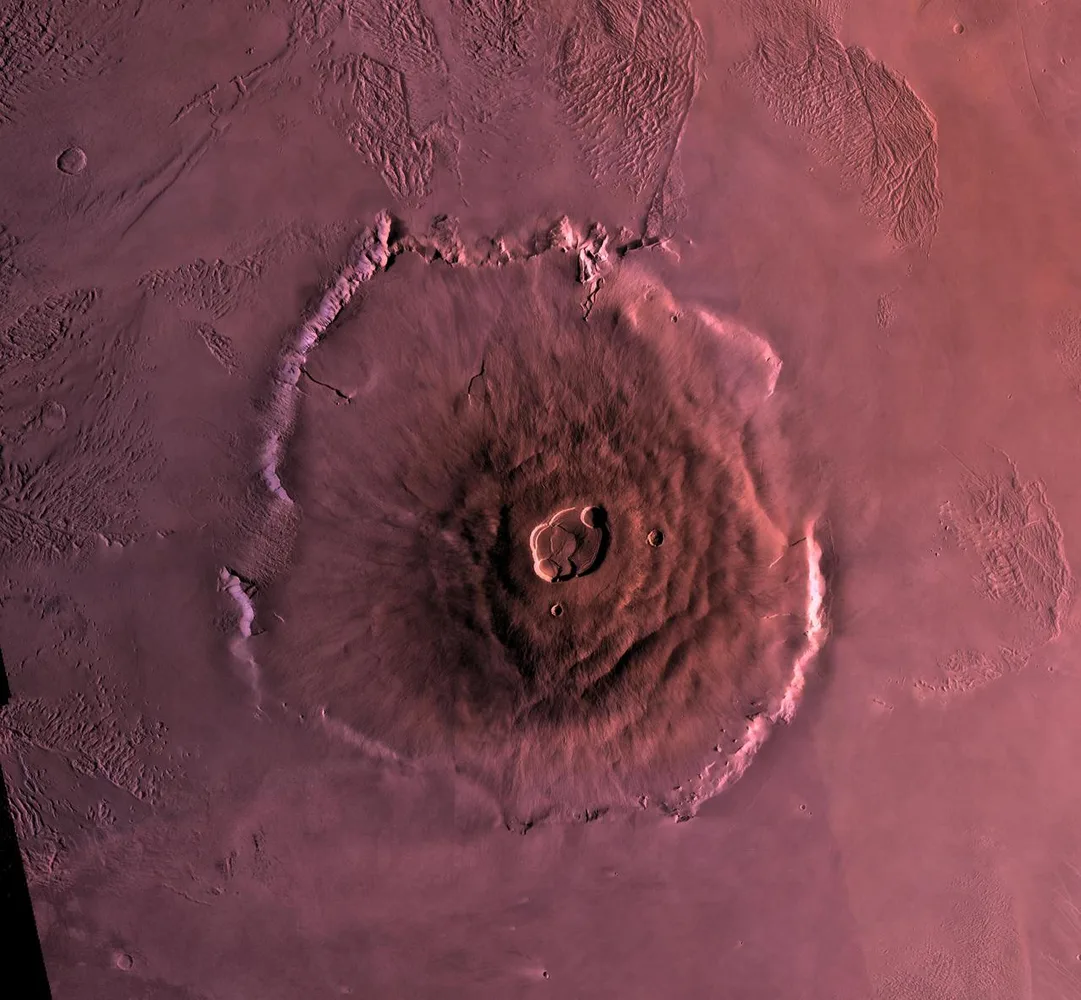
Olympus Mons
Image: NASA/JPL/USGS · PIA00300 · NASA sourceOverview
Olympus Mons stands as a colossal monument to Mars' volcanic past, rising as the tallest known volcano in our solar system. This massive shield volcano towers approximately 21.2 kilometers (13.2 miles) above the surrounding plains, nearly three times the height of Mount Everest. Its base spans roughly 600 kilometers (370 miles) in diameter, making it roughly the size of the state of Arizona.
Located in the Tharsis volcanic region, Olympus Mons formed over millions of years through repeated basaltic lava flows. The volcano's gentle slopes, averaging only 5 degrees, are characteristic of shield volcanoes formed by low-viscosity lava flows that spread over vast distances before cooling.
What makes Olympus Mons particularly intriguing for future Mars exploration is its extensive network of lava tubes - natural underground tunnels that could serve as ready-made shelters for human habitats, protecting settlers from radiation, extreme temperatures, and dust storms.
Vital Statistics
Geological Features
Volcanic Structure
Olympus Mons exhibits a classic shield volcano profile with a large summit caldera complex measuring about 80 kilometers wide and up to 3 kilometers deep. The caldera formed through repeated collapse events as magma chambers emptied during eruptions.
The volcano's aureole, a distinctive scarp that surrounds the base, drops 2-8 kilometers to the surrounding plains. This feature may have formed through gravitational spreading of the massive volcanic pile or through interaction with underlying sediments.
Lava Tube Networks
Extensive lava tube systems have been identified across Olympus Mons' flanks. These tubes formed when the outer surface of lava flows cooled and solidified while molten lava continued to flow beneath, eventually draining to leave hollow conduits.
On Mars' lower gravity environment, these lava tubes can be significantly larger than their Earth counterparts - potentially up to several kilometers wide and hundreds of kilometers long.
Lava Tubes as Human Habitats
Natural Protection Systems
Lava tubes on Olympus Mons offer unparalleled natural protection for human settlements. The thick rock ceiling provides excellent shielding from cosmic radiation, solar radiation, and micrometeorite impacts. The stable internal environment maintains relatively constant temperatures year-round.
Radiation Shielding
Meters of rock overhead block harmful cosmic rays and solar radiation that pose serious health risks on the surface.
Temperature Stability
Interior temperatures remain stable, avoiding the extreme daily temperature swings experienced on the surface.
Atmospheric Protection
Natural shelter from dust storms and the thin Martian atmosphere that provides little protection from space hazards.
Engineering Advantages
- • Ready-made structures: No need to excavate or build pressure vessels from scratch
- • Scalable expansion: Multiple connected tubes allow for modular habitat growth
- • Structural integrity: Natural arches proven stable over millions of years
- • Access points: Skylights and collapsed sections provide natural entrances
Resource Potential
- • Volcanic materials: Rich in useful minerals for construction and manufacturing
- • Water ice deposits: Potential ice accumulation in permanently shadowed areas
- • Elevated position: Above much of the atmospheric dust for clear communications
- • Geothermal potential: Residual heat from the volcanic system
Terraforming and Settlement Assessment
With a terraforming rating of 8/10, Olympus Mons offers exceptional potential for human settlement, primarily due to its extensive lava tube systems. The combination of natural protection, structural integrity, and resource availability makes it one of the most promising locations for establishing large-scale human presence on Mars.
Settlement Advantages
- • Immediate radiation protection
- • Stable environmental conditions
- • Multiple habitat sites available
- • Natural structural support
- • Elevated communications position
- • Rich mineral resources
Engineering Considerations
- • Sealing for atmospheric pressure
- • Access and transportation challenges
- • Interior lighting requirements
- • Emergency egress planning
- • Communication relay systems
- • Life support redundancy
Primary Challenges
- • Extreme altitude effects
- • Very thin atmospheric pressure
- • Distance from other settlements
- • Limited surface water access
- • Potential seismic activity
- • Transportation logistics
Current Research and Future Exploration
Ongoing Studies
Scientists continue to study Olympus Mons using orbital imagery from missions like Mars Reconnaissance Orbiter and Mars Express. These missions have identified numerous lava tube skylights and mapped the volcano's structure in unprecedented detail.
Research Priorities
- • Lava tube mapping and characterization
- • Structural integrity assessment
- • Resource distribution studies
- • Geochemical composition analysis
- • Climate and weather patterns
Future Mission Concepts
- • Lava tube exploration rovers
- • Skylight descent missions
- • Underground habitat demonstrations
- • Resource utilization experiments
- • Communication relay deployment