Medusae Fossae Formation
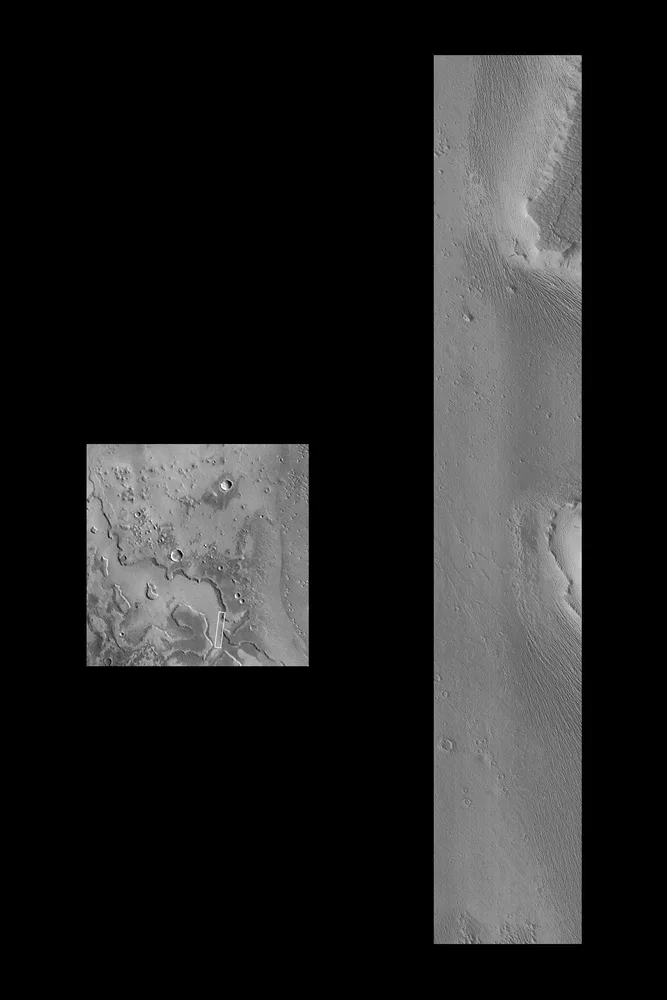
Medusae Fossae Formation
Image: NASA/JPL/Malin Space Science Systems · PIA01159 · NASA sourceOverview
The Medusae Fossae Formation (MFF) stands as one of Mars' most enigmatic geological features, extending discontinuously for over 5,000 kilometers along the planet's equator. This massive deposit, covering an area equal to 20% the size of the continental United States, represents the largest source of dust on Mars and potentially one of its most significant water ice reservoirs.
Recent 2024 discoveries have revolutionized our understanding of the MFF, revealing extensive water ice deposits beneath its surface that could cover the entire planet in an ocean 1.5 to 2.7 meters deep if melted. This finding transforms the formation from a simple dust source into a potential treasure trove of resources for future Mars exploration.
The formation's easily eroded volcanic ash and dust composition has played a crucial role in shaping Mars' global atmosphere and climate, while its buried ice deposits suggest complex geological processes involving both volcanic activity and water ice accumulation over billions of years.
Quick Facts
Formation and Volcanic Origins
The Medusae Fossae Formation is composed of weakly cemented particles, most likely formed by massive volcanic ash deposits from pyroclastic flows or similar explosive volcanic activity. These materials were deposited over extensive periods during Mars' Amazonian era, creating one of the largest sedimentary formations on the planet.
Volcanic Sources
Recent research suggests multiple volcanic sources contributed to the MFF, including ash from Olympus Mons, Apollinaris Mons, Arsia Mons, and Pavonis Mons. The formation may have originated from pumice rafts and massive explosive eruptions that distributed ash across vast equatorial regions.
Dust Production
The MFF's easily eroded nature makes it the single largest source of dust on Mars. Its chemical composition, rich in sulfur and chlorine, provides the best match to global Martian dust measurements, confirming its role as the primary contributor to Mars' dusty atmosphere.
2024 Breakthrough: Hidden Water Ice Reservoirs
Massive Subsurface Ice Discovery
Using updated data from Mars Express's MARSIS radar, scientists discovered extensive layered deposits of water ice beneath the MFF, reaching depths of up to 3.7 kilometers. These deposits are protected by a layer of dry dust or ash several hundred meters thick, preserving them from sublimation.
If all the suspected water ice in the formation melted, it would create a global ocean covering Mars to a depth of 1.5 to 2.7 meters - making it one of the largest water reservoirs on the planet outside the polar caps.
Implications for Mars Exploration
This discovery fundamentally changes our understanding of water distribution on Mars. The MFF's equatorial location makes it far more accessible than polar ice caps, potentially providing a crucial water source for future human missions and settlements.
The protective dust layer above the ice suggests that these deposits could remain stable over geological timescales, offering a reliable and accessible water resource for in-situ resource utilization (ISRU) activities.
Mars' Primary Dust Factory
The Medusae Fossae Formation plays a crucial role in Mars' atmospheric dynamics as the planet's largest dust source. Long-term deflation and erosion of the formation have significantly contributed to the global Martian dust reservoir that creates the planet's characteristic dusty atmosphere and global dust storms.
Chemical Fingerprint
The MFF has the highest abundance of sulfur and chlorine compounds, providing the best chemical match to surface measurements of Martian dust.
Global Distribution
Volume estimates suggest that eroded materials from the MFF have distributed dust across the entire planet through atmospheric transport.
Climate Impact
The continuous dust production affects Mars' radiation balance, atmospheric opacity, and seasonal weather patterns.
Dust Production Statistics
Terraforming Assessment
Moderate Terraforming Potential
Significant water resources but challenging dust environment
Advantages
- • Massive water ice deposits (up to 3.7 km deep)
- • Equatorial location for accessibility
- • Easily mined volcanic ash deposits
- • Construction material availability
- • Protected subsurface ice reservoirs
- • Prime ISRU water extraction site
Challenges
- • Continuous dust production and accumulation
- • Extreme dust storm activity
- • Equipment maintenance issues
- • Respiratory hazards from fine particles
- • Solar panel efficiency reduction
- • Radiation exposure concerns
Scientific Significance
Planetary Climate Archive
The layered structure of dust, ash, and ice in the MFF preserves a detailed record of Mars' climate evolution over billions of years. Each layer represents different epochs of volcanic activity, dust accumulation, and ice deposition, providing insights into how Mars transitioned from its ancient climate to current conditions.
Atmospheric Dynamics
Understanding the MFF's role as Mars' primary dust source is crucial for modeling planetary atmospheric processes, dust storm formation, and long-term climate patterns. This knowledge is essential for planning future missions and understanding Mars' current and past habitability potential.
Future Exploration Opportunities
The 2024 discovery of massive water ice deposits has elevated the MFF to a high-priority target for future Mars exploration. The formation's equatorial location and abundant resources make it an ideal candidate for establishing sustainable human presence on Mars.
Priority Investigations
- • Detailed subsurface ice mapping
- • Water extraction feasibility studies
- • Dust mitigation technology testing
- • Volcanic ash resource utilization
- • Climate record analysis
ISRU Potential
- • Water extraction from subsurface ice
- • Volcanic ash for construction materials
- • Dust particle analysis for hazard assessment
- • Atmospheric dust source monitoring
- • Ice-ash layer dating techniques