Mawrth Vallis
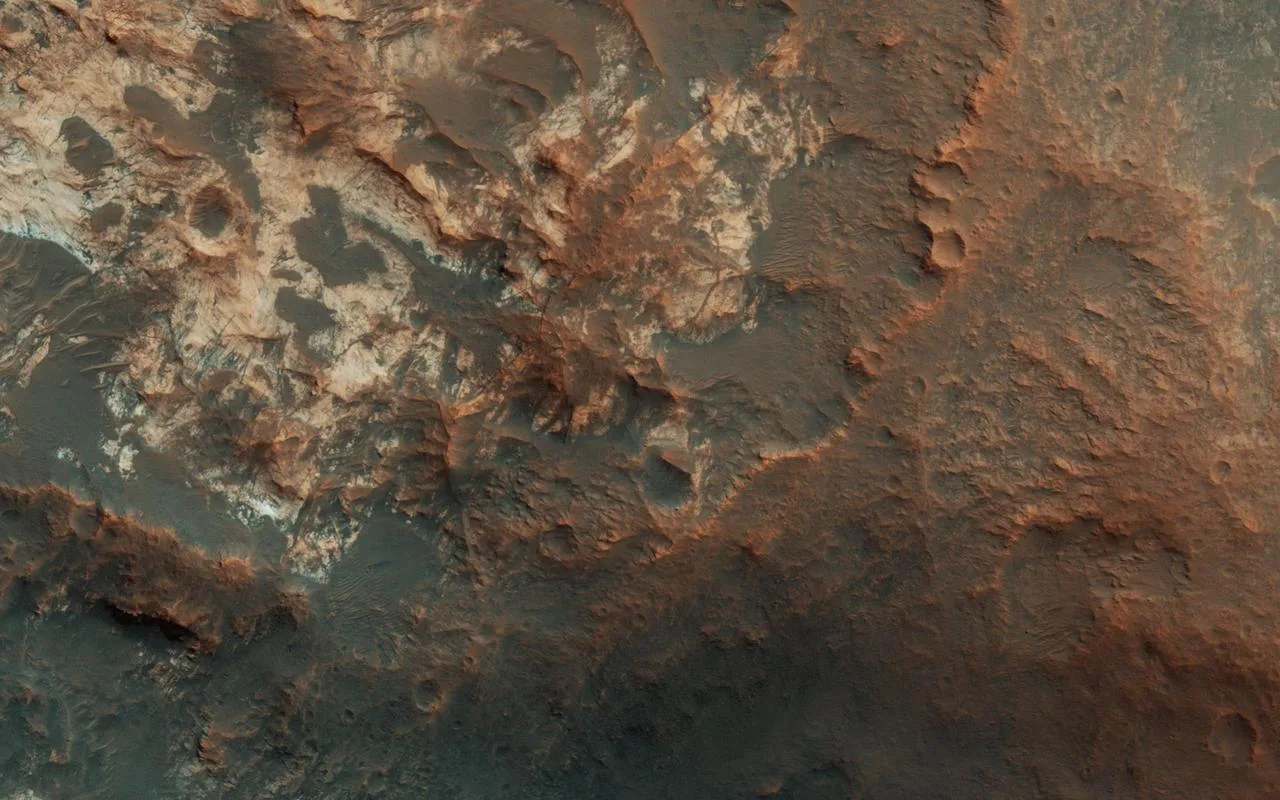
The Entrance to Mawrth Vallis
Image: NASA/JPL-Caltech/Univ. of Arizona · PIA21555 · NASA sourceOverview
Mawrth Vallis represents one of Mars' most extraordinary repositories of clay minerals, containing the highest abundance and diversity of phyllosilicates discovered on the planet. This ancient valley system preserves a thick, complex profile of clay minerals that tell the story of extensive, long-term water activity during Mars' early history.
The region harbors some of the largest phyllosilicate outcrops on Mars, with up to 65% smectite clay content by volume in certain areas. These layered deposits, formed through billions of years of water-rock interactions, provide unparalleled insights into the environmental conditions that may have supported life during Mars' Noachian period.
Recent research has identified Mawrth Vallis as showcasing the highest degree of aqueous alteration identified on Mars from orbit, making it a unique window into the planet's ancient hydrogeologic history and a compelling target for astrobiological investigations.
Quick Facts
Phyllosilicate Treasure Trove: Mars' Clay Mineral Capital
The phyllosilicate deposits at Mawrth Vallis exhibit a specific and scientifically significant stratigraphic sequence that records changing aqueous environments over geological time. This layered arrangement provides crucial evidence for understanding how Mars' early climate evolved and what conditions may have supported habitability.
Lower Sequence
- • Fe/Mg-smectite clay minerals
- • Formed via basalt alteration
- • Neutral pH water conditions
- • Extensive aqueous activity evidence
- • Ancient cratered terrain origin
- • Primary alteration products
Upper Sequence
- • Hydrated silica deposits
- • Montmorillonite and kaolinite
- • Fe and Mg leaching evidence
- • Extended aqueous events
- • Chemical weathering products
- • Environmental transition markers
Evidence for Long-Lived Surface Water
Aqueous Alteration Timeline
The thick stacks of clay minerals at Mawrth Vallis indicate chemical alteration of massive rock sequences through interaction with liquid water. This process required sustained water activity over periods ranging from tens of thousands to millions of years, far exceeding brief episodes of water activity.
Multiple mineral horizons in the layered outcrops signify changing geochemical environments, suggesting Mars experienced complex, evolving water chemistry during its early history.
Environmental Conditions
Research suggests the Fe³⁺-rich smectites formed in warm surface environments with mean annual temperatures of 5-10°C and seasonal highs reaching 20-30°C. These conditions, combined with rainfall and surface leaching, created ideal environments for clay formation.
The formation timescale of tens to hundreds of thousands of years indicates Mars maintained favorable conditions for extended periods during the Noachian era.
Mineral Diversity and Significance
CRISM spectral analysis has revealed an extraordinary diversity of hydrated minerals at Mawrth Vallis, including aluminum smectite, iron/magnesium smectite, hydrated silica, kaolinite group minerals, and various iron oxides. This assemblage represents the most complete record of aqueous mineral formation processes discovered on Mars.
The presence of alunite, recently discovered in the region, provides evidence for localized evaporative environments, adding another layer of complexity to the area's aqueous history and suggesting diverse microenvironments existed within the broader water-rich setting.
Exceptional Astrobiological Potential
Phyllosilicate deposits represent some of the most promising environments for the preservation of ancient life signatures. The clay minerals at Mawrth Vallis have exceptional capability to preserve organic compounds and potential biosignatures over geological timescales, making them ideal targets for astrobiological investigations.
Organic Preservation Potential
Clay minerals easily preserve microscopic life on Earth, and laboratory experiments suggest phyllosilicates could have served as reaction centers for organic molecules, potentially playing a role in the origin of life processes.
Habitable Environment Indicators
The layered phyllosilicate-rich outcrops record ancient active chemical environments that could have supported habitable conditions. The neutral pH conditions inferred from the mineral assemblages would have been conducive to life processes.
Biosignature Detection Target
The ancient phyllosilicates could preserve evidence of ecosystems over geologic timescales if life was present on ancient Mars. The diverse mineral assemblages provide multiple targets for biosignature detection strategies.
Habitability Factors
ExoMars Mission and Future Exploration
Mawrth Vallis has been extensively evaluated as a prime landing site for the European Space Agency's ExoMars mission. While Oxia Planum was ultimately selected as the primary landing site, Mawrth Vallis remains designated as a backup site and continues to be recognized as one of Mars' most scientifically compelling exploration targets.
Mission Evaluation
Mawrth Vallis was evaluated through multiple landing site selection meetings, with two ellipses in the region proposed for both Mars2020 and ExoMars missions due to its exceptional scientific value.
Scientific Objectives
The region's rich geological record from Mars' wetter past makes it ideal for ExoMars' goals of searching for signs of past life and investigating ancient environmental conditions.
2028 Mission Plans
With ExoMars receiving additional funding and targeting a 2028 launch, Mawrth Vallis remains a high-priority backup target for the mission's subsurface drilling and organic analysis capabilities.
2024 Research Developments
Future In Situ Exploration Study
A comprehensive 2024 study published in Astrobiology magazine has reinforced Mawrth Vallis as "A Fascinating Place for Future In Situ Exploration." The research highlights key science targets and their astrobiological interests within the proposed landing ellipses.
The study describes opportunities for human exploration in terms of both scientific discoveries and resource utilization, positioning Mawrth Vallis as a cornerstone location for Mars exploration.
Alunite Discovery
Recent discovery of alunite minerals in the candidate ExoMars landing site provides evidence for localized evaporative environments. This finding adds complexity to our understanding of the region's aqueous history and suggests diverse water chemistry conditions existed.
The presence of alunite indicates periods of concentrated brine formation, potentially creating unique microenvironments for extremophile-type organisms.
Advanced Spectral Analysis
Continued analysis using Mars Reconnaissance Orbiter's CRISM instrument has revealed increasingly detailed views of the phyllosilicate stratigraphy. These observations show that the complexity of mineral layering exceeds initial estimates, suggesting even more extensive and varied aqueous processes than previously recognized.
The detailed mapping has identified specific targets within the region that show the highest potential for organic preservation, guiding future mission planning and landing site refinement.
Terraforming Assessment
High Terraforming Potential
Exceptional clay resources and proven long-term water history
Advantages
- • Highest clay mineral abundance on Mars
- • Proven extended water activity history
- • Neutral pH soil conditions
- • Excellent agricultural potential
- • Natural water retention capabilities
- • Diverse mineral resources
- • Potential subsurface water access
Challenges
- • Limited current surface water
- • Dust accumulation concerns
- • Radiation exposure issues
- • Temperature extremes
- • Atmospheric pressure variations
- • Access to surrounding regions
Scientific Significance
Mars Hydrogeologic Archive
Mawrth Vallis provides the most complete and accessible record of Mars' ancient water activity available for study. The thick, layered phyllosilicate deposits preserve a detailed archive of changing environmental conditions during the planet's most habitable period, offering insights crucial for understanding planetary climate evolution and the potential for life beyond Earth.
Astrobiology Laboratory
The region serves as a natural laboratory for studying how life might have originated and been preserved on Mars. The combination of extended aqueous activity, diverse chemical environments, and exceptional preservation potential makes Mawrth Vallis arguably the most promising location for detecting evidence of ancient Martian life.
Future Exploration Roadmap
Despite not being selected for the primary ExoMars landing site, Mawrth Vallis remains one of the highest-priority targets for future Mars exploration. Its unparalleled clay mineral deposits and astrobiological potential ensure it will continue to be a cornerstone location for understanding Mars' past and potential for life.
Exploration Priorities
- • Subsurface drilling to 2+ meters depth
- • Comprehensive organic compound analysis
- • Detailed phyllosilicate stratigraphy
- • Biosignature detection surveys
- • Ancient climate reconstruction
Technology Requirements
- • Advanced drilling capabilities
- • High-resolution spectroscopy
- • Sample caching systems
- • Long-range mobility platforms
- • Environmental monitoring suites