Isidis Planitia (Beagle 2)
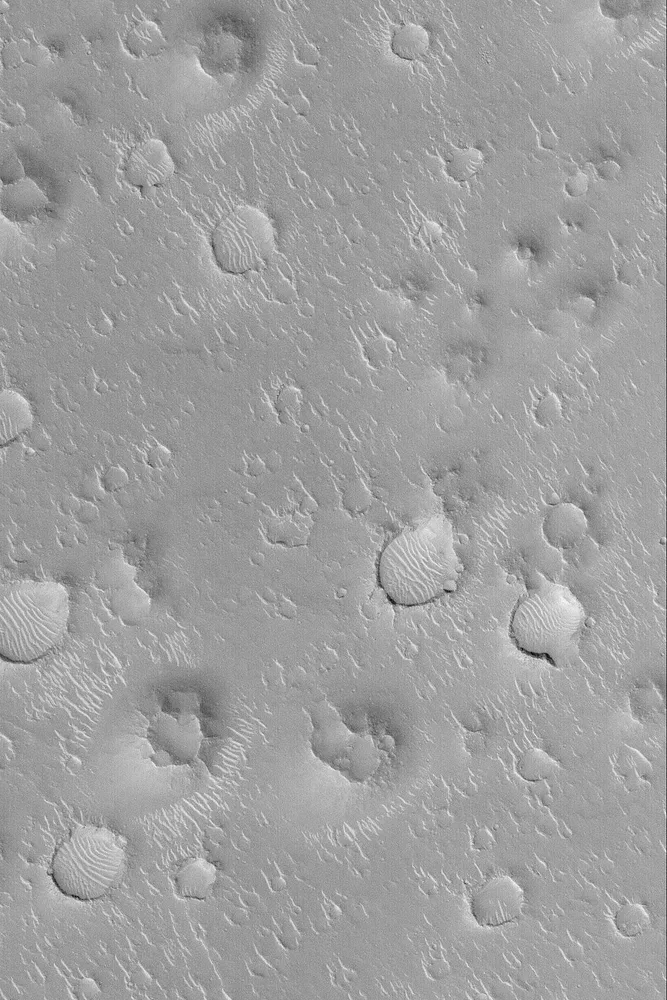
Isidis Planitia
Image: NASA/JPL/Malin Space Science Systems · PIA04838 · NASA sourceOverview
Isidis Planitia represents one of Mars' most geologically significant ancient impact basins, serving as the intended landing site for the ill-fated but scientifically important Beagle 2 mission. This massive impact structure, approximately 1,900 kilometers in diameter, holds the distinction of being the third-largest confirmed impact basin on Mars, formed during the violent early history of the planet approximately 3.9 billion years ago.
The basin exposes some of the oldest hydrated crust on Mars, providing a unique window into the planet's ancient past when water was more abundant and conditions were potentially more hospitable to life. The rim of this ancient impact crater preserves evidence of massive glaciation events and extensive water-rock interactions that occurred billions of years ago.
Recent discoveries have revealed that Isidis Planitia contains magnesium carbonate deposits, indicating the presence of ancient non-acidic water conditions that would have been favorable for potential life. The basin's complex geological history includes episodes of volcanic activity, catastrophic flooding, and massive glaciation, making it a natural laboratory for understanding Mars' climate evolution.
Quick Facts
The Beagle 2 Mission: A Tale of Ambition and Discovery
The Beagle 2 lander, launched as part of the European Space Agency's Mars Express mission in 2003, was designed to search for signs of past or present life on Mars. Named after Charles Darwin's famous ship, the small lander carried sophisticated instruments to analyze Martian soil and rocks for organic compounds and other biosignatures.
Mission Goals
- • Search for organic compounds and biosignatures
- • Analyze soil and rock composition
- • Study atmospheric composition
- • Investigate subsurface water content
Scientific Instruments
- • Gas Analysis Package (GAP)
- • X-ray spectrometer
- • Mössbauer spectrometer
- • Rock corer and sample delivery system
The Lost and Found Story
Contact with Beagle 2 was lost on Christmas Day 2003, just hours before its planned landing. For over a decade, the fate of the lander remained a mystery until NASA's Mars Reconnaissance Orbiter spotted it on the surface in January 2015, revealing that it had successfully landed but failed to fully deploy its solar panels.
The discovery showed that Beagle 2 had landed just 5 kilometers from its intended target in Isidis Planitia, demonstrating the precision of its landing system. Though the mission couldn't complete its scientific goals, its target location choice proved scientifically prescient.
Ancient Impact Basin: A 3.9-Billion-Year Time Capsule
Formation and Impact History
Isidis Planitia was formed by a catastrophic asteroid or comet impact during the Late Heavy Bombardment period of the early solar system. The impact was so massive that it created a basin nearly 2,000 kilometers across, penetrating deep into Mars' crust and exposing ancient materials.
This impact basin is believed to be the last major basin-forming impact on Mars, making it a crucial marker in understanding the planet's geological timeline and the transition from the violent early bombardment period to more stable conditions.
Hydrated Crust Discovery
The basin rim exposes some of the oldest hydrated crust on Mars, containing minerals that formed through water-rock interactions billions of years ago. These ancient hydrated minerals provide direct evidence that water was present on Mars very early in its history.
The preservation of these hydrated minerals in the impact basin's rim material suggests that early Mars had an environment where liquid water could persist long enough to significantly alter rock compositions through chemical weathering processes.
Three Major Geological Episodes
1. Impact-Dominated Episode (Until ~3.8 Ga)
Formation of the basin by massive impact, followed by continued bombardment and mass-wasting processes that shaped the initial basin structure and rim materials.
2. Volcanic and Glacial Episode (~3.8-2.8 Ga)
Widespread volcanic resurfacing combined with massive glaciation events. Ice sheets covered both the rim and floor of the basin, eroding an estimated 35,000-50,000 cubic kilometers of material.
3. Wind-Dominated Episode (~2.8 Ga-Present)
Transition to the current arid climate with primarily wind-driven surface modification, dust accumulation, and minor erosion processes shaping the modern landscape.
Modern Discoveries and Scientific Insights
Magnesium Carbonate Evidence
Mars Reconnaissance Orbiter detected magnesium carbonate around the Isidis basin, a mineral that forms only in neutral to alkaline water conditions. This discovery indicates that ancient water in this region was not acidic, creating pH conditions more favorable for potential life.
The presence of carbonates suggests that early Mars had a thicker atmosphere with higher CO2 levels, supporting theories about a warmer, wetter early Mars climate that could have sustained liquid water on the surface.
Volcanic Cone Formations
The basin contains numerous conical landforms interpreted as tuff cones formed during explosive magma-ice interactions. These cones, 300-500 meters in diameter and ~30 meters high, suggest that volcanic activity occurred when subsurface ice was present.
The alignment of these cones in chains with characteristic furrows indicates fissure volcanism along circumferential dikes, providing evidence for the complex interplay between volcanism and water/ice during Mars' early history.
Subsurface Water Indicators
Analysis of thermal inertia patterns and geological structures suggests that Isidis Planitia has significant potential for subsurface water resources. The eroded materials from massive glaciation events were likely saturated with ice and water, forming wet deposits on the basin floor that may persist in the subsurface today.
Evidence for concentration and remobilization of volatiles makes Isidis an area of particular interest for astrobiology research and future exploration missions seeking to understand Mars' potential for past or present habitability.
Terraforming Assessment
Good Terraforming Potential
Ancient water evidence and mineral resources
Advantages
- • Oldest hydrated crust on Mars
- • Evidence of ancient neutral-pH water
- • Magnesium carbonate deposits
- • Potential subsurface water/ice resources
- • Diverse geological history
- • Large, relatively flat basin floor
- • Volcanic activity history (geothermal potential)
Challenges
- • Limited confirmed current water access
- • Ancient age of most geological activity
- • Dust accumulation issues
- • Radiation exposure on basin floor
- • Distance from polar ice caps
- • Complex subsurface structure
Scientific Significance
Window to Ancient Mars
Isidis Planitia serves as a unique window into Mars' ancient past, preserving evidence of the planet's early climate conditions when water was more abundant. The basin's geological record spans nearly 4 billion years, providing crucial insights into the transition from a potentially habitable early Mars to its current arid state.
Astrobiology Research Target
The discovery of magnesium carbonates and evidence of ancient neutral-pH water conditions makes Isidis Planitia a high-priority target for astrobiology research. The basin's potential for preserving ancient biosignatures in its hydrated crust and sedimentary deposits could provide definitive evidence of past life on Mars.
Impact Basin Evolution Model
As one of the best-preserved large impact basins on Mars, Isidis Planitia provides a natural laboratory for understanding how massive impacts shape planetary surfaces and influence long-term geological evolution. Its complex history of volcanism, glaciation, and erosion offers insights applicable to impact basins throughout the solar system.
Future Exploration Opportunities
Despite the failure of the Beagle 2 mission to complete its scientific objectives, Isidis Planitia remains a high-priority target for future Mars exploration. The basin's unique geological features and potential for preserving ancient biosignatures make it an ideal location for advanced astrobiology missions and eventual human exploration.
Proposed Mission Objectives
- • Deep drilling into hydrated crust layers
- • Carbonate deposit analysis for biosignatures
- • Subsurface ice/water resource mapping
- • Volcanic cone composition studies
- • Ancient atmospheric reconstruction
Human Exploration Benefits
- • Large, flat landing area for heavy equipment
- • Potential subsurface water resources
- • Diverse geological materials for study
- • Central location for regional exploration
- • Historical significance for Mars exploration