Horowitz Crater RSL
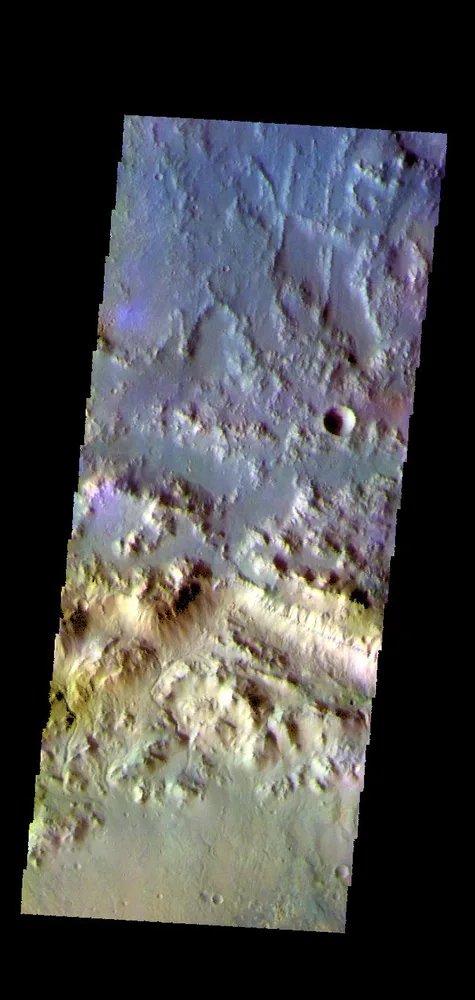
Horowitz Crater - False Color
Image: NASA/JPL-Caltech/ASU · PIA21548 · NASA sourceOverview
Horowitz Crater stands out as one of Mars' most intriguing locations for studying recurring slope lineae (RSL) - mysterious dark streaks that appear and disappear seasonally on crater slopes. These enigmatic features have captured the attention of planetary scientists as potential evidence of contemporary water activity on Mars, representing some of the most dynamic geological processes currently observable on the planet.
The crater's steep slopes, ranging from 25° to 40°, provide ideal conditions for RSL formation during Mars' warmest seasons. These narrow features, typically 0.5 to 5 meters wide, exhibit distinctive dark markings that incrementally grow during warm periods and fade during cold seasons, showing a strong correlation with solar heating and surface temperatures.
What makes Horowitz Crater particularly significant is the spectral evidence for hydrated salts detected on these slopes, supporting hypotheses about briny water involvement in RSL formation. However, recent studies have sparked scientific debate about whether these features represent active liquid water processes or dry granular flows.
Quick Facts
Recurring Slope Lineae: Mars' Dynamic Features
Recurring slope lineae at Horowitz Crater represent some of the most dynamic geological features currently active on Mars. These seasonal phenomena demonstrate a clear correlation with temperature cycles, appearing during the warmest months and fading during cooler periods, suggesting ongoing physical processes in the near-surface environment.
Formation Characteristics
RSL exhibit slow incremental growth, appearing first as small dark patches that gradually extend downslope over the course of weeks to months. They favor equator-facing slopes that receive maximum solar heating, with peak activity correlating with surface temperatures reaching their seasonal maximum.
Seasonal Behavior
The features demonstrate remarkable seasonal fidelity, with annual fading and recurrence patterns that have been observed across multiple Martian years. This predictable behavior suggests a repeatable physical process tied to environmental conditions rather than random geological events.
Evidence for Briny Water Activity
Hydrated Salt Detection
Spectroscopic analysis using the Compact Reconnaissance Imaging Spectrometer (CRISM) has detected hydrated salts on RSL slopes at Horowitz Crater. The salts most consistent with spectral features include magnesium perchlorate, magnesium chlorate, and sodium perchlorate.
These findings strongly support the hypothesis that RSL form as a result of contemporary water activity, as these salts would likely require liquid water for their formation and preservation in the observed hydrated state.
Brine Formation Mechanisms
The detected perchlorate salts can significantly lower the freezing point of water, allowing liquid brines to exist at temperatures well below pure water's freezing point. This property makes them ideal candidates for enabling liquid water activity in Mars' current climate.
Proposed mechanisms include deliquescence, where atmospheric water vapor is absorbed by salt crystals to form liquid solutions, or interactions between different salt types that produce landslide-triggering chemical reactions.
Contemporary Water Activity Evidence
The combination of seasonal behavior, temperature correlation, and hydrated salt detection provides compelling evidence for contemporary water activity at Horowitz Crater. While the actual volumes of liquid water involved may be very small, the implications for understanding current Martian processes are significant.
This evidence suggests that Mars is not as geologically inactive as previously thought, with ongoing processes that could provide insights into the planet's current habitability potential and water cycle dynamics.
The RSL Formation Debate
While initial interpretations of RSL strongly favored liquid water processes, the scientific community continues to debate their exact formation mechanisms. Recent studies have proposed alternative explanations involving dry granular flows, challenging the water-based models and highlighting the complexity of these features.
Liquid Water Hypothesis
Brines from subsurface aquifers or atmospheric processes create sufficient water activity to mobilize surface materials.
Dry Flow Hypothesis
Temperature-triggered dry granular flows involving dust and fine particles, without requiring liquid water.
Hybrid Mechanisms
Combination processes involving minimal water activity that triggers larger-scale dry granular movements.
Current Research Focus
Planetary Protection and Habitability
Special Regions Classification
Due to the potential involvement of liquid water, RSL sites like Horowitz Crater are classified as "Uncertain Regions, to be treated as Special Regions" under planetary protection guidelines. This classification recognizes that these areas might harbor conditions where Earth life could potentially survive.
This designation requires special precautions for any future missions to these areas to prevent forward contamination and preserve the integrity of potential Martian biological processes.
Habitability Assessment
While the brines associated with RSL may be too cold or too salty for most Earth life, they represent some of the most potentially habitable environments currently known on Mars. The combination of liquid water (even if briny) and seasonal activity suggests dynamic chemical processes.
These conditions might support extremophile organisms adapted to high-salt, low-temperature environments, similar to organisms found in Earth's most extreme environments.
Terraforming Assessment
Good Terraforming Potential
Active water processes and diverse geological features
Advantages
- • Evidence of contemporary water activity
- • Hydrated salt deposits for resource extraction
- • Seasonal process understanding for prediction
- • Diverse slope environments for habitat placement
- • Active geological processes
- • Potential subsurface water sources
Challenges
- • Extremely saline water conditions
- • Limited water volumes
- • Steep terrain navigation difficulties
- • Seasonal temperature extremes
- • Planetary protection restrictions
- • Dust accumulation issues
Scientific Significance
Contemporary Mars Processes
Horowitz Crater's RSL provide crucial insights into currently active geological and potentially hydrological processes on Mars. Understanding these features helps scientists determine whether Mars remains geologically and hydrologically active, with implications for current habitability and future human exploration strategies.
Astrobiology Research
As one of the few locations on Mars with potential contemporary liquid water activity, Horowitz Crater represents a prime target for astrobiology research. The site offers opportunities to study how life might survive in extreme saline, low-temperature conditions and to search for biosignatures in currently active environments.
Future Exploration Opportunities
Horowitz Crater represents a high-priority target for future Mars exploration, particularly for missions focused on astrobiology and understanding contemporary Martian processes. However, its classification as a Special Region requires careful mission planning to meet planetary protection requirements.
Research Priorities
- • In-situ RSL formation monitoring
- • Subsurface water detection
- • Salt deposit detailed analysis
- • Seasonal process characterization
- • Life detection experiments
Mission Considerations
- • Planetary protection compliance
- • Sterilization requirements
- • Remote sensing capabilities
- • Multi-season monitoring
- • Sample containment protocols