Hellas Basin
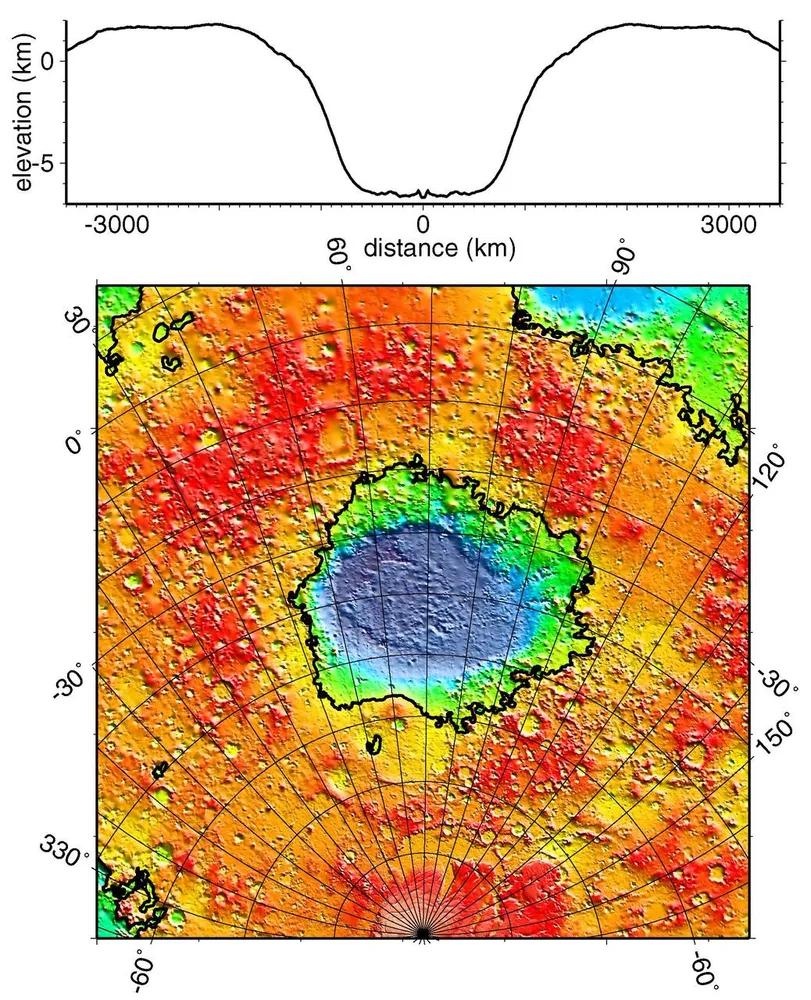
Regional Topographic Model of the Hellas Basin
Image: NASA/JPL/GSFC · PIA02033 · NASA sourceOverview
Hellas Basin stands as a monument to the violent early history of our solar system. With a diameter of 2,300 kilometers and a depth reaching 9 kilometers below the Martian datum, it is not only the largest impact crater on Mars but the largest well-preserved impact structure in the entire solar system.
This colossal basin was carved during the Late Heavy Bombardment period, approximately 4.1 to 3.8 billion years ago, when a massive asteroid or protoplanet estimated to be around 370 kilometers in diameter struck the southern highlands of Mars with devastating force.
Today, Hellas Basin serves as both a geological laboratory and a natural atmospheric laboratory, with unique features ranging from possible buried glaciers to honeycomb terrain formations that continue to puzzle planetary scientists.
Quick Facts
The Great Impact
The formation of Hellas Basin represents one of the most catastrophic events in Mars' history. The impact that created this massive depression released energy equivalent to billions of nuclear weapons, fundamentally altering the planet's geology and possibly its early atmosphere.
Impact Mechanics
- • Impactor velocity: ~20-25 km/s
- • Energy released: >10²⁶ joules
- • Ejecta thrown across entire planet
- • Created ring mountains up to 2 km high
- • Excavated material to 15+ km depth
Geological Consequences
- • Triggered global hot rainfall
- • Induced massive volcanic activity
- • Created antipodal effects at Alba Patera
- • Altered planetary crustal structure
- • Exposed deep crustal materials
Extraordinary Geological Features
Honeycomb Terrain
One of Mars' most mysterious features, the honeycomb terrain consists of flat-lying polygonal "cells" with concentric layers resembling a giant honeycomb. These formations may have been created by ice diapirs - massive ice bodies pushing up through overlying rock layers.
The ice layers responsible could have been 100 meters to 1 kilometer thick, creating dome structures that were later eroded to reveal the current circular patterns.
Buried Glaciers
SHARAD radar data from Mars Reconnaissance Orbiter has detected buried ice deposits up to 450 meters thick in eastern Hellas. These "lobate debris aprons" are actually glaciers of water ice hidden beneath protective layers of dirt and rock.
The region shows evidence of multiple glaciation periods, suggesting complex climate cycles that repeatedly accumulated and melted ice deposits over geological time.
Twisted "Taffy Pull" Terrain
The floor of Hellas Basin displays remarkable twisted bands and viscous flow features that resemble taffy being pulled and stretched. These formations suggest that the basin floor materials underwent deformation, possibly due to ice content or thermal processes.
High-resolution HiRISE images reveal intricate patterns of ridges and valleys that indicate flow-like behavior of materials across the basin floor, creating some of the most alien-looking landscapes on Mars.
Atmospheric Laboratory
Hellas Basin's immense depth creates a unique atmospheric environment on Mars. At the bottom of the basin, atmospheric pressure reaches 1.15 kPa - nearly twice the Martian average and remarkably close to the triple point of water (0.61 kPa), where liquid water can theoretically exist under the right temperature conditions.
Dust Storm Genesis
The basin frequently generates localized dust storms that can grow into planet-spanning events. The unique topography and atmospheric dynamics create ideal conditions for dust lifting and transport.
Temperature Variations
The deep basin experiences more moderate temperature swings than the Martian surface average, with the thicker atmosphere providing better thermal regulation.
Cloud Formation
Water ice clouds frequently form in and around the basin, particularly during southern winter when atmospheric conditions favor condensation.
Pressure Comparison
Ancient Water and Ice Activity
Evidence of Ancient Lakes
Orbital imagery has revealed what appear to be ancient shorelines, delta formations, and terraced deposits within Hellas Basin. These features suggest that the basin may have periodically contained large bodies of liquid water during Mars' more hospitable past.
The combination of the basin's depth, which provides higher atmospheric pressure, and possible greenhouse warming could have created conditions suitable for stable liquid water for extended periods.
Glacial Activity
Subsurface radar mapping has revealed extensive ice deposits buried beneath dust and debris. These buried glaciers represent remnants of past ice ages when Mars' axial tilt was different, allowing ice to accumulate at lower latitudes.
The ice deposits show evidence of flow patterns and multiple episodes of accumulation and melting, indicating that Hellas Basin has experienced repeated cycles of glaciation throughout its history.
Terraforming Assessment
Moderate Terraforming Potential
Unique advantages offset by significant challenges
Advantages
- • Highest atmospheric pressure on Mars
- • Potential access to buried ice deposits
- • Natural atmospheric containment
- • Large flat areas for development
- • Possible liquid water conditions
- • Rich mineral diversity from impact
Challenges
- • Extreme southern latitude location
- • Severe dust storm activity
- • Limited direct sunlight in winter
- • Complex terrain features
- • Uncertain ice accessibility
- • Potential for toxic perchlorates
Scientific Exploration
Orbital Studies
Multiple Mars orbiters have studied Hellas Basin extensively, using everything from high-resolution cameras to ground-penetrating radar. These studies have revealed the basin's complex geological history and hidden ice deposits.
- • Mars Reconnaissance Orbiter (MRO)
- • Mars Express
- • Mars Global Surveyor
- • Mars Odyssey
Future Mission Potential
Hellas Basin represents a prime target for future Mars missions, particularly those focused on subsurface exploration and ice prospecting. The basin's unique features could provide insights into Mars' climate history and potential for past life.
- • Ice drilling missions
- • Atmospheric research stations
- • Geological sampling expeditions
- • Climate monitoring networks
Theoretical Terraforming Concepts
Hellas Basin has been the subject of numerous theoretical terraforming studies due to its unique atmospheric properties. Some concepts propose using the basin as a testing ground for atmospheric manipulation technologies or as a contained environment for initial terraforming experiments.
Atmospheric Concentration
Theoretical proposals include using the basin's natural depth to concentrate denser atmospheres, potentially creating habitable zones within the depression while the rest of Mars remains hostile.
- • Dense gas injection experiments
- • Greenhouse gas concentration
- • Partial pressure dome concepts
Ice Utilization
The buried ice deposits could serve as both a water source and a means of atmospheric enhancement through controlled sublimation and chemical processing.
- • Large-scale ice extraction
- • Atmospheric water injection
- • Pressure regulation systems