Gale Crater
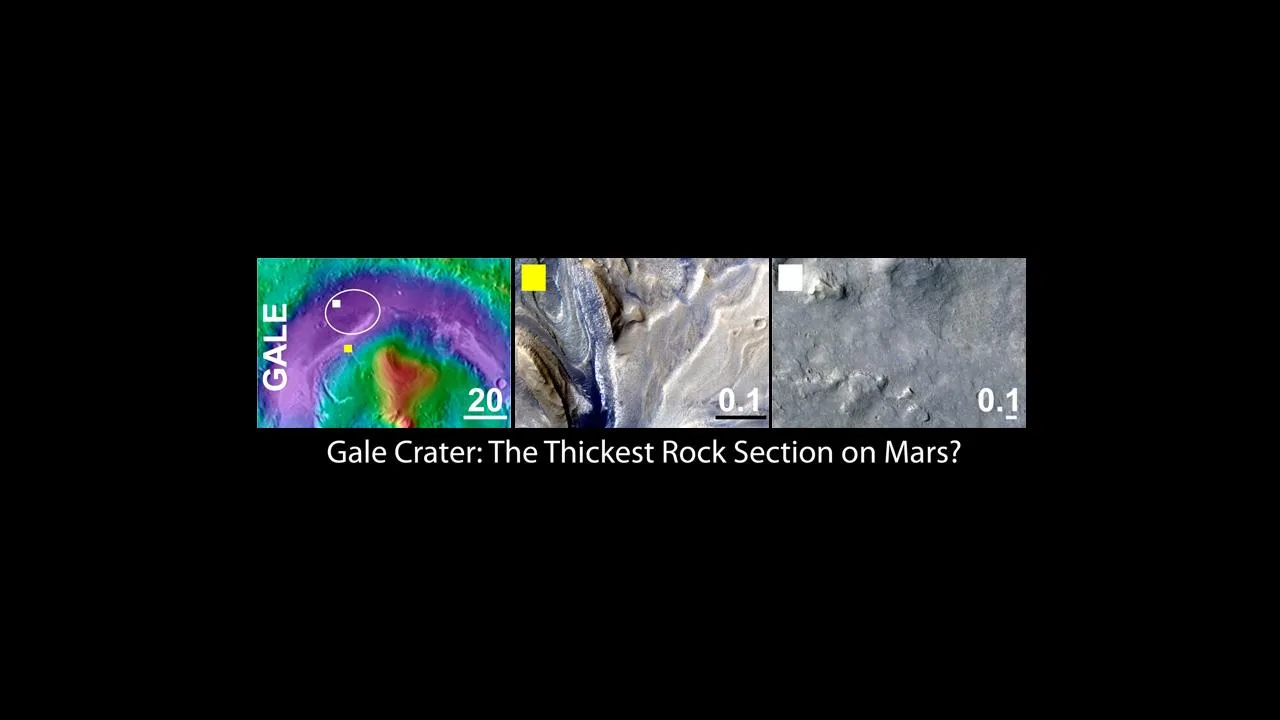
Gale Crater, the Selected Landing Site for Curiosity
Image: NASA/JPL-Caltech/UA · PIA14301 · NASA sourceOverview
Gale Crater stands as one of Mars' most scientifically significant locations, serving as the primary exploration site for NASA's Curiosity rover since 2012. This 154-kilometer-wide impact crater was formed approximately 3.5-3.8 billion years ago and contains compelling evidence of Mars' ancient habitability potential.
The crater is dominated by Mount Sharp (Aeolis Mons), a 5.5-kilometer-tall layered mountain that preserves billions of years of Martian geological history. Each layer tells a story of changing environmental conditions, from ancient lake beds to desert formations, making it a natural archive of Mars' climatic evolution.
Recent discoveries by Curiosity have revolutionized our understanding of water's persistence on Mars, with evidence suggesting that water activity continued much longer than previously thought, potentially extending the window for past habitability.
Quick Facts
Mount Sharp: A Geological Time Machine
Mount Sharp represents one of the most remarkable geological features on Mars. This towering mountain wasn't built by volcanic activity, but rather by billions of years of sedimentary deposition. The layered structure preserves a detailed record of Mars' environmental transitions, from wet to dry conditions.
Lower Layers
Rich in clay minerals formed in neutral pH water conditions, indicating a potentially habitable ancient environment. These layers suggest extensive lake systems existed for extended periods.
Upper Layers
Contain sulfate minerals formed in more acidic conditions, marking the transition to the drier, more hostile environment we see today.
Recent Groundbreaking Discoveries
Pure Sulfur Crystals (2024)
In a stunning discovery, Curiosity accidentally crushed a rock revealing yellow sulfur crystals - the first pure elemental sulfur found on Mars. This discovery has puzzled scientists as it forms only under very specific conditions not previously associated with Gale Crater.
The discovery occurred in the Gediz Vallis channel, an area carved by ancient floods that left dramatic evidence of Mars' violent water activity.
Boxwork Formations (2024)
Curiosity has captured unprecedented close-up images of "boxwork" patterns - crisscrossing ridges formed by ancient groundwater. These formations provide dramatic evidence that water persisted in the region much longer than previously thought.
The patterns stretch across miles and were likely formed when groundwater left mineral deposits in rock fractures, which then hardened and became visible through erosion.
Extended Water Activity Evidence
Recent analysis of sediment deformation structures suggests that water persisted in Gale Crater during Mars' supposed "dry period." This finding extends the timeline of potential habitability and challenges our understanding of Mars' climate evolution.
Chemical reactions caused by water have left "halo" shapes in rocks, providing clear evidence of water-rock interactions that occurred long after the main lake period ended.
Curiosity's Journey of Discovery
Since landing on August 5, 2012, NASA's Curiosity rover has transformed our understanding of Gale Crater and Mars' potential for ancient life. The rover has drilled 41 rock samples, analyzed thousands of targets, and traveled over 29 kilometers across the crater floor and up Mount Sharp's foothills.
2012-2014: Initial Discoveries
Early confirmation of ancient lake environment with neutral pH water suitable for life.
2014-2019: Mount Sharp Ascent
Detailed analysis of the mountain's layers revealing Mars' climate transition.
2020-Present: Revolutionary Discoveries
Sulfur crystals, boxwork formations, and evidence of extended water activity.
Mission Achievements
Terraforming Assessment
High Terraforming Potential
Excellent geological diversity and resources
Advantages
- • Proven ancient habitability
- • Diverse mineral resources
- • Evidence of sustained water activity
- • Varied topography with Mount Sharp
- • Rich geological history
- • Accessible location near equator
Challenges
- • Dust accumulation issues
- • Seasonal temperature variations
- • Limited current water access
- • Radiation exposure on crater floor
- • Pervasive Martian dust
Scientific Significance
Astrobiology Impact
Gale Crater has provided the strongest evidence to date that Mars once had conditions suitable for life. The discovery of organic compounds, seasonal methane variations, and ancient lake environments has made it a cornerstone location for astrobiology research.
Climate Evolution Understanding
The detailed stratigraphic record preserved in Mount Sharp provides unprecedented insights into how Mars transitioned from a potentially habitable world to its current state, informing models of planetary climate evolution.
Future Exploration Opportunities
While Curiosity continues its mission, Gale Crater remains a priority target for future Mars exploration. The recent discoveries of sulfur crystals and boxwork formations have opened new questions about Mars' geological processes and potential for past life.
Proposed Investigations
- • Detailed sulfur formation analysis
- • Boxwork pattern comprehensive mapping
- • Mount Sharp summit exploration
- • Advanced organic compound detection
Sample Return Potential
- • Preserved organic-rich samples
- • Diverse mineral assemblages
- • Ancient lake sediments
- • Unique sulfur formations