Elysium Planitia (InSight)
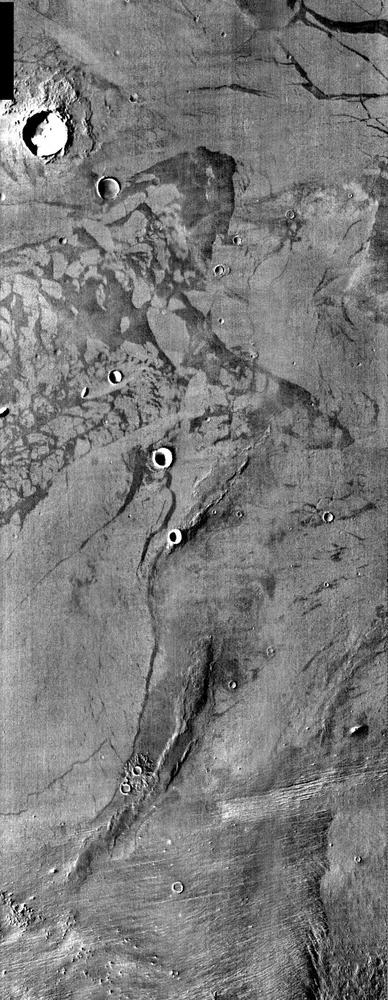
Elysium Planitia
Image: NASA/JPL/Arizona State University · PIA06824 · NASA sourceOverview
Elysium Planitia is a vast plain in Mars' northern lowlands that became the first location where humanity could listen to the deep interior of the Red Planet. Serving as the landing site for NASA's InSight (Interior Exploration using Seismic Investigations, Geodesy and Heat Transport) mission, this region has revolutionized our understanding of Mars' internal structure and seismic activity.
Located approximately 600 kilometers from Curiosity's landing site at Gale Crater, Elysium Planitia was carefully selected for its remarkably flat terrain and optimal conditions for sensitive seismic measurements. The region sits between ancient highlands and younger volcanic features, providing a unique window into Mars' geological evolution.
From 2018 to 2022, InSight recorded over 1,300 marsquakes, transforming our understanding of Mars from a geologically dead world to one that remains seismically active, with implications for both planetary science and future human exploration.
Quick Facts
Geological Structure and Formation
Subsurface Stratigraphy
InSight's seismic data revealed a complex subsurface structure beneath Elysium Planitia. The uppermost layer consists of approximately 3 meters of sandy regolith, beneath which lies a 15-meter thick layer of coarse blocky ejecta from ancient meteorite impacts.
Below this, two distinct basaltic layers tell the story of Mars' volcanic history: shallow lava flows from the Amazonian period (1.7 billion years old) overlying much older Hesperian-era basalts (3.6 billion years old) formed during widespread volcanic activity.
Regional Geology
Elysium Planitia occupies a strategic position between diverse geological terrains. The plains are bounded by ancient highlands to the south and west, ridges of the Medusae Fossae Formation to the east, and volcanic deposits from Elysium Mons—Mars' second-largest volcanic complex—to the north.
The region also lies within 1,500 kilometers of Cerberus Fossae, one of Mars' youngest fault systems, which continues to generate marsquakes that InSight detected throughout its mission.
InSight Mission Discoveries
Seismological Breakthroughs
InSight's SEIS (Seismic Experiment for Interior Structure) instrument achieved unprecedented sensitivity, detecting ground motions in the nanometer range and recording the lowest seismic noise floor ever measured in the solar system. This sensitivity allowed the mission to confirm that Mars remains seismically active.
- First deployment of a seismometer on Mars since the Viking missions
- Detected marsquakes as large as magnitude 5.0
- Mapped Mars' internal structure from crust to core
- Revealed ongoing tectonic activity across the planet
Interior Structure Revealed
InSight's data allowed scientists to map Mars' interior structure for the first time, revealing a thinner crust than expected, a liquid iron core, and a mantle with different properties than Earth's. These discoveries fundamentally changed our understanding of Mars' formation and evolution.
Atmospheric Dynamics
Beyond seismology, InSight provided detailed measurements of Mars' weather patterns, dust devil activity, and seasonal atmospheric changes. The mission revealed how wind-induced vibrations could be used to study subsurface structure.
Settlement and Research Potential
With a terraforming rating of 6/10, Elysium Planitia offers moderate potential for future human settlement. Its strategic location near the equator provides excellent solar energy potential, while the wealth of geological data from InSight makes it one of the most scientifically valuable locations on Mars.
Strategic Advantages
Scientific Infrastructure
- • Comprehensive seismic monitoring data
- • Detailed subsurface structure knowledge
- • Proven landing site accessibility
- • Established weather monitoring baseline
Physical Advantages
- • Exceptionally flat terrain for construction
- • Optimal latitude for solar power generation
- • Geological stability assessment available
- • Dust accumulation patterns understood
Settlement Challenges
- • Limited surface water resource access
- • Ongoing seismic activity risks
- • Dust accumulation on solar panels
- • High radiation exposure levels
- • Temperature extremes (-95°C to -5°C)
Future Research and Exploration
Building on InSight's Legacy
InSight's revolutionary discoveries at Elysium Planitia have established this location as a cornerstone for future Mars exploration. The mission's comprehensive dataset provides essential baseline information for understanding Mars' geological hazards and resource potential for human settlement.
The detailed knowledge of subsurface structure, seismic activity patterns, and atmospheric dynamics makes Elysium Planitia an ideal location for advanced scientific research stations and potentially one of the first permanent human research outposts on Mars.
Research Applications
- • Continued seismic monitoring network
- • Subsurface resource exploration
- • Atmospheric dynamics research
- • Geological hazard assessment
Settlement Potential
- • Scientific research outpost
- • Geological monitoring station
- • Seismological research center
- • Solar power generation facility