Deuteronilus Mensae
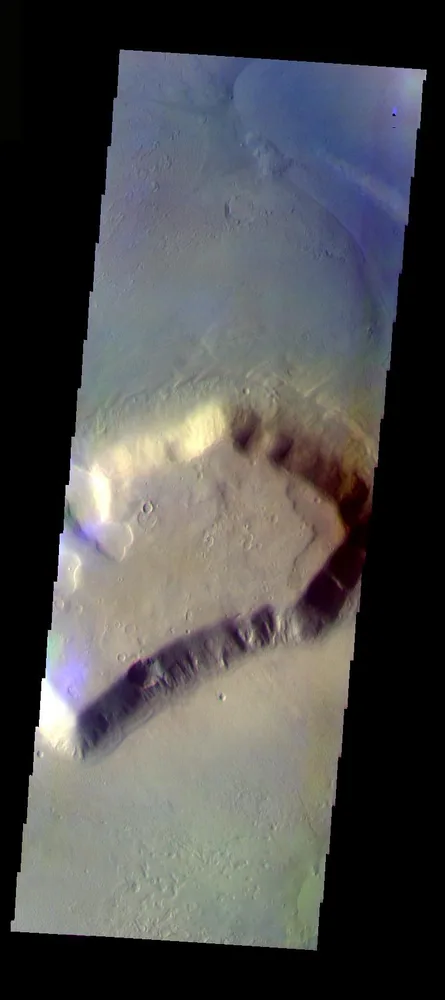
Deuteronilus Mensae
Image: NASA/JPL/Arizona State University · PIA07954 · NASA sourceOverview
Deuteronilus Mensae, located on the northern edge of Arabia Terra at approximately 39° North and 23° East, represents one of Mars' most spectacular examples of debris-covered glacial systems. This region lies along the Martian dichotomy boundary, where highland terrain transitions to the northern lowlands, creating ideal conditions for ice preservation.
The area is dominated by extensive lobate debris aprons (LDAs) that emanate from mesas and ridges, forming lobe-shaped formations with distinctive pitted and lineated textures. These features are interpreted as debris-covered glaciers composed primarily of water ice, protected from sublimation by an insulating layer of surface debris.
Orbital radar sounding has confirmed that these debris aprons contain material with dielectric properties consistent with high ice purity (>80% water ice), making Deuteronilus Mensae a significant reservoir of accessible water resources for future Mars exploration and settlement.
Quick Facts
Debris-Covered Glacial Systems
The debris-covered glaciers of Deuteronilus Mensae represent some of the most well-preserved ice deposits on Mars. These formations, known as lobate debris aprons (LDAs), commonly emanate from mesas and show distinctive flow patterns, lineated textures, and pitted surfaces that indicate the movement of ice-rich material.
Glacial Characteristics
- • Lobate debris aprons emanating from mesas
- • Distinctive pitted and lineated textures
- • Flow patterns indicating ice movement
- • Debris cover protecting underlying ice
- • High ice purity (>80% water ice)
- • Evidence of multiple glacial events
Formation Process
- • Climate-driven ice accumulation
- • Debris cover from mass wasting
- • Viscous flow of ice-debris mixture
- • Insulation preventing sublimation
- • Long-term preservation mechanisms
- • Periglacial landscape evolution
Ice Resources and Composition
High Ice Purity Confirmed
Orbital radar sounding surveys using the SHARAD instrument have confirmed that lobate debris aprons in Deuteronilus Mensae contain material with dielectric properties consistent with >80% water ice content.
The high ice purity makes these deposits excellent candidates for water extraction and ISRU operations, with minimal processing required to obtain pure water.
Polygonal Ground Indicators
The presence of polygonal ground patterns throughout Deuteronilus Mensae indicates widespread subsurface ice. These features form from repeated freeze-thaw cycles and thermal contraction of ice-rich ground.
Polygonal terrain is commonly associated with permafrost environments and provides strong evidence for extensive ground ice distribution beyond the visible debris aprons.
Ice Preservation and Age
The debris cover acts as natural insulation, protecting the underlying ice from sublimation over geological time scales. While the most recent latitude-dependent mantling deposits may still be ice-rich, older deposits may show varying degrees of preservation depending on their burial depth and debris thickness.
Evidence suggests that Deuteronilus Mensae has experienced multiple glacial events throughout Mars' history, with the suite of features representing outcomes of various glacial episodes driven by changes in Mars' orbital parameters.
Climate History and Formation
Obliquity-Driven Ice Ages
The formation of ice deposits in Deuteronilus Mensae is linked to large changes in Mars' obliquity (axial tilt), which has varied from the current 25 degrees to potentially over 80 degrees throughout geological time.
During high obliquity periods, water ice could be stable at mid-latitudes, leading to the accumulation of the massive ice deposits we observe today.
Multiple Glacial Episodes
Research has identified evidence for extensive glaciation in Deuteronilus Mensae, with inferences pointing toward multiple glacial events in past epochs. This suggests repeated cycles of ice accumulation and retreat.
The preservation of features from different glacial episodes provides a record of Mars' climate evolution and the dynamic nature of water ice distribution.
Landscape Evolution
The current landscape of Deuteronilus Mensae has been sculpted by glacial processes over millions of years. Mesas, their slopes, and surrounding aprons may all be saturated with water ice beneath an insulating blanket of dust and debris.
Flow patterns in wide valleys and along ridges indicate movement of debris mixed with ice toward surrounding areas, creating formations that resemble rock glaciers commonly found in cold-climate regions on Earth.
Resource Accessibility and ISRU Potential
Excellent Water Resource Access
High-purity ice with natural protection systems
Resource Advantages
- • >80% water ice purity confirmed
- • Natural debris protection from sublimation
- • Extensive distribution across region
- • Multiple accessible deposit locations
- • Well-preserved over geological time
- • Reduced processing requirements
Extraction Considerations
- • Debris removal for ice access
- • Slope stability on debris aprons
- • Equipment protection from rockfall
- • Seasonal accessibility variations
- • Ice depth and thickness mapping
- • Landing site selection criteria
Terraforming Assessment
High Terraforming Potential
Extensive water ice resources with natural preservation
Advantages
- • Abundant high-purity water ice
- • Natural ice preservation systems
- • Diverse topographic features
- • Evidence of climate stability
- • Multiple resource extraction sites
- • Well-documented glacial history
- • Elevation diversity for settlements
Challenges
- • High latitude cold temperatures
- • Limited solar energy availability
- • Steep terrain accessibility issues
- • Debris removal requirements
- • Seasonal climate variations
- • Radiation exposure concerns
Future Exploration Opportunities
Deuteronilus Mensae represents a prime target for missions focused on water resource characterization and glacial history studies. The region's well-preserved debris-covered glaciers offer unique opportunities to study Mars' climate evolution while accessing significant water resources.
Research Priorities
- • Detailed ice thickness mapping
- • Debris layer composition analysis
- • Glacial flow pattern studies
- • Climate history reconstruction
- • Resource extraction feasibility
- • Landing site safety assessment
Mission Applications
- • Water resource utilization studies
- • ISRU technology demonstrations
- • Glacial geology investigations
- • Climate monitoring stations
- • Sample return mission targets
- • Long-term settlement planning