Chryse Planitia (Viking 1)
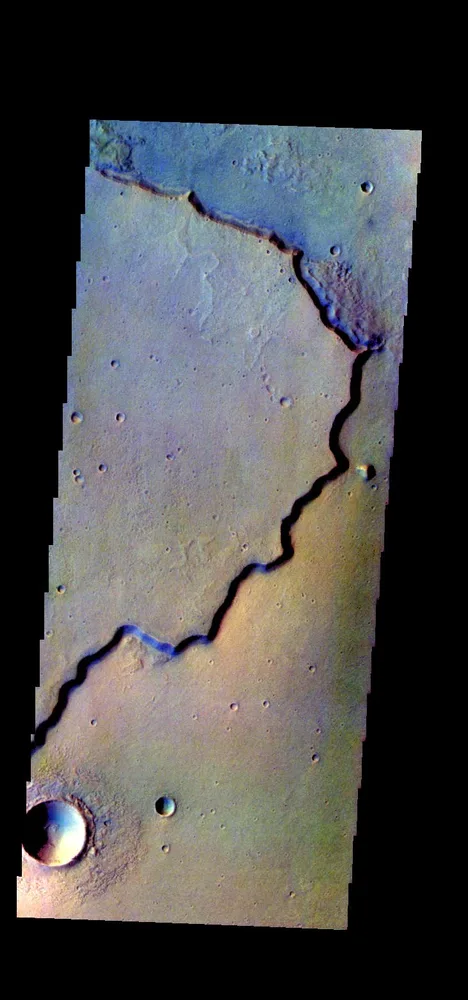
Chryse Planitia - False Color
Image: NASA/JPL-Caltech/ASU · PIA21162 · NASA sourceOverview
Chryse Planitia, meaning "Golden Plain," holds the distinction of being humanity's first successful landing site on Mars. On July 20, 1976—exactly seven years after the Apollo 11 Moon landing—NASA's Viking 1 lander touched down on this ancient floodplain in Mars' northern hemisphere, beginning the era of surface exploration of the Red Planet.
Located at the mouth of massive ancient outflow channels, Chryse Planitia was carved by catastrophic floods that occurred billions of years ago. These floods transported materials from many different Martian regions, creating a diverse geological landscape that provided Viking 1 with an excellent natural laboratory for studying Mars' composition and history.
Recent research suggests that Viking 1 may have landed on terrain formed by an ancient megatsunami, adding another fascinating chapter to our understanding of this historically significant site and Mars' violent geological past.
Quick Facts
Geological Features and Formation
Ancient Flood Plains
Chryse Planitia was shaped by massive ancient floods that carved through the Martian landscape billions of years ago. The basin contains materials from various geological units, including Hesperian Ridged plains materials that feature lunar-like mare ridges and both fresh and buried impact craters.
The surface consists of smooth plains with prominent wrinkle ridges, mesas and plateaus, etched surfaces, fields of knobs, and low shields that may be volcanic in origin. This diversity reflects the complex geological processes that shaped the region over billions of years.
Megatsunami Theory
Recent studies suggest that Viking 1 landed near the edge of an ancient megatsunami deposit created by an asteroid impact about 3.4 billion years ago. This catastrophic event would have displaced massive amounts of water and sediment across the northern plains.
The megatsunami hypothesis helps explain the diverse rock types and sedimentary features observed at the landing site, as such an event would have mixed materials from vast areas of the Martian surface into a complex deposit.
Viking 1 Mission Legacy
Historic First Landing
Viking 1's successful landing at Chryse Planitia marked humanity's first controlled touchdown on the Martian surface. The mission was designed not only to study the surface and atmosphere but also to search for signs of microbial life using three sophisticated biological experiments.
- First successful Mars surface mission in human history
- Operated for over 6 years, far exceeding its planned mission
- Conducted first in-situ analysis of Martian soil
- Provided first detailed weather measurements from Mars
Scientific Discoveries
Viking 1 revealed the presence of sand drifts, boulders, and rocks (including the famous "Big Joe" boulder). The lander's robotic arm collected soil samples and conducted the first chemical analysis of Martian regolith, providing baseline data still used today.
Life Detection Experiments
The three biology experiments discovered unexpected chemical activity in Martian soil but provided no definitive evidence for living microorganisms. These results continue to be debated and have informed the design of subsequent life-detection missions.
Settlement and Resource Potential
With a terraforming rating of 7/10, Chryse Planitia offers good potential for future human settlement. Its historical significance as the first successful landing site, combined with decades of accumulated knowledge about local conditions, makes it a well-understood location for establishing human presence on Mars.
Strategic Advantages
Historical Knowledge
- • 47+ years of accumulated data
- • Proven landing site accessibility
- • Well-characterized surface conditions
- • Baseline atmospheric measurements
Physical Advantages
- • Relatively flat terrain for construction
- • Diverse geological materials
- • Evidence of past water activity
- • Ancient floodplain sediments
Settlement Challenges
- • Limited current water resource access
- • Frequent dust storm activity
- • High radiation exposure levels
- • Temperature extremes (-85°C to -5°C)
- • Potential geological instability
Future Exploration and Research
Return to Chryse Planitia
As humanity prepares for eventual crewed missions to Mars, Chryse Planitia's status as a well-characterized, historically significant site makes it a compelling candidate for future exploration. The site offers both practical advantages and symbolic importance for establishing permanent human presence on Mars.
Modern instruments could revisit Viking 1's controversial life-detection results with more sophisticated techniques, potentially resolving decades-old scientific questions while preparing the groundwork for human habitation infrastructure.
Future Mission Potential
- • Human landing site candidate
- • Historical preservation site
- • Resource utilization testing
- • Climate monitoring station
Research Opportunities
- • Re-examine Viking life-detection data
- • Study megatsunami deposits
- • Long-term atmospheric monitoring
- • Geological resource assessment