Cerberus Fossae
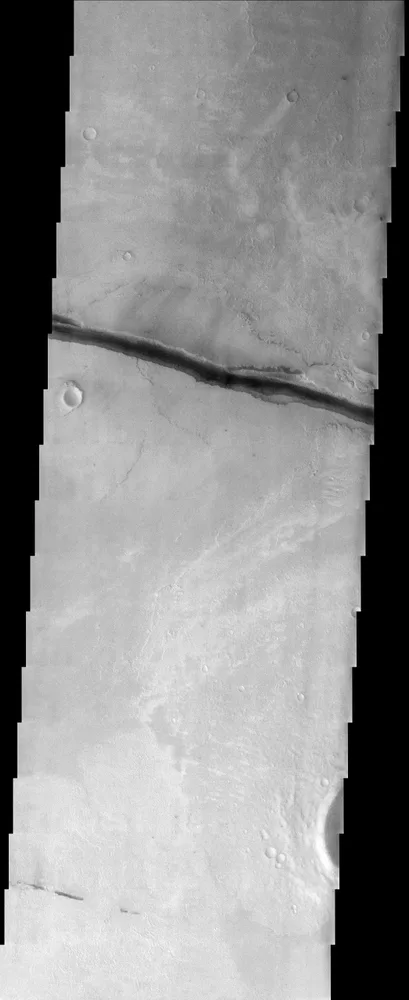
Cerberus Fossae
Image: NASA/JPL/Arizona State University · PIA04751 · NASA sourceOverview
Cerberus Fossae represents one of Mars' most geologically active regions, consisting of a series of parallel fractures extending over 1,200 kilometers across the Elysium Planitia. This dramatic fissure system has emerged as the primary source of marsquakes detected by NASA's InSight mission, challenging our understanding of Mars as a geologically dormant world.
The fossae (Latin for "trenches") are relatively young geological features, formed within the last few million years through tectonic activity driven by volcanic processes beneath the surface. These parallel fractures represent active extension of the Martian crust, with some segments showing evidence of recent lava flows and pyroclastic deposits.
Recent discoveries from InSight's seismometer have revealed that over 90% of detected marsquakes originate from this region, suggesting ongoing magmatic activity at depths of 30-50 kilometers. This makes Cerberus Fossae a cornerstone location for understanding Mars' current geological processes and potential for continued volcanic activity.
Quick Facts
Geological Formation and Structure
The Cerberus Fossae system formed through extensional tectonics, where the Martian crust stretched and fractured due to underlying magmatic processes. These parallel grabens (down-dropped blocks) create a distinctive pattern visible from orbit, with individual fossae ranging from hundreds of meters to several kilometers in width.
Formation Mechanism
Tectonic extension driven by magma intrusion creates parallel fractures as the crust pulls apart. This process is ongoing, with seismic evidence suggesting continued magmatic activity at depths of 30-50 kilometers beneath the surface.
Volcanic Features
Recent pyroclastic deposits less than 250,000 years old indicate explosive volcanic activity. Dark dust deposits suggest even more recent volcanism, possibly within the last 50,000 years.
Revolutionary InSight Discoveries
Marsquake Epicenter (2022-2024)
InSight's seismometer detected 1,319 marsquakes during its mission, with over 90% originating from Cerberus Fossae. This concentration of seismic activity was unprecedented and revealed that Mars is far more geologically active than previously thought.
The strongest marsquakes reached magnitudes of 4.7, releasing significant seismic energy equivalent to 1.4–5.6 × 10¹⁵ N·m per year, representing at least half of Mars' total planetary seismicity.
Active Magmatic Processes
Low-frequency marsquakes suggest a structurally weak, potentially warm source region consistent with molten lava or magma at depth. This challenges the long-held belief that Mars is volcanically dormant.
Spectral analysis indicates magmatic activity occurring at 40-kilometer depths, with the graben system continuing to actively open and extend, driven by ongoing subsurface processes.
Seismic Monitoring Breakthrough
The concentration of seismic activity at Cerberus Fossae was initially surprising to scientists who expected more distributed seismicity across Mars. Instead, they discovered that most Martian surface faults are not seismically active, with activity focused on this single population of tectonic structures.
This finding has revolutionized understanding of Martian tectonics, suggesting that active geological processes are more localized but more intense than previously modeled, with implications for understanding Mars' thermal evolution and interior dynamics.
Evidence of Recent Volcanic Activity
Geological evidence suggests that Cerberus Fossae has experienced volcanic activity much more recently than most of Mars. Dark-toned deposits and fresh-appearing lava flows indicate volcanism may have occurred within the past 50,000 years—extremely recent in geological terms.
Pyroclastic Deposits
Evidence of explosive volcanism less than 250,000 years old, including volcanic ash deposits in the central fossae region.
Lava Flow Evidence
Fresh-appearing basaltic flows with minimal crater density, suggesting emplacement within the last few million years.
Dark Surface Deposits
Distinctive dark-toned materials possibly related to very recent volcanic activity, within the last 50,000 years.
Volcanic Timeline
Terraforming Assessment
Moderate Terraforming Potential
Active geology with significant challenges
Advantages
- • Active geological processes indicate thermal energy
- • Recent volcanic activity suggests accessible magma
- • Potential geothermal energy resources
- • Fresh volcanic materials for construction
- • Ongoing outgassing could contribute to atmosphere
- • Well-studied seismic activity for planning
Challenges
- • High seismic risk from ongoing marsquakes
- • Potential for future volcanic eruptions
- • Geological instability complicates construction
- • Limited surface water resources
- • Dust accumulation in fracture systems
- • Unpredictable future activity patterns
Scientific Significance
Martian Seismology Revolution
Cerberus Fossae has fundamentally changed our understanding of Mars' interior structure and dynamics. The concentration of seismic activity here has provided unprecedented insights into the planet's crustal structure, thermal state, and ongoing geological processes, establishing Mars as a seismically active world.
Active Planet Paradigm
The discovery of ongoing magmatic activity challenges the traditional view of Mars as a geologically dead planet. Evidence for recent volcanism and active magma chambers suggests Mars remains thermally active, with implications for understanding planetary evolution and the potential for ongoing atmosphere modification through volcanic outgassing.
Future Exploration Potential
As one of Mars' most geologically active regions, Cerberus Fossae presents both unique opportunities and challenges for future exploration. The ongoing seismic activity and evidence of recent volcanism make it a priority target for understanding Mars' current state and future evolution.
Research Priorities
- • Direct sampling of recent volcanic deposits
- • Continuous seismic monitoring network
- • Subsurface magma chamber detection
- • Gas emission monitoring and analysis
- • Thermal mapping of active regions
Engineering Considerations
- • Seismic-resistant infrastructure design
- • Real-time hazard monitoring systems
- • Geothermal energy exploitation potential
- • Safe distance protocols for settlements
- • Emergency response planning