Ares Vallis (Pathfinder)
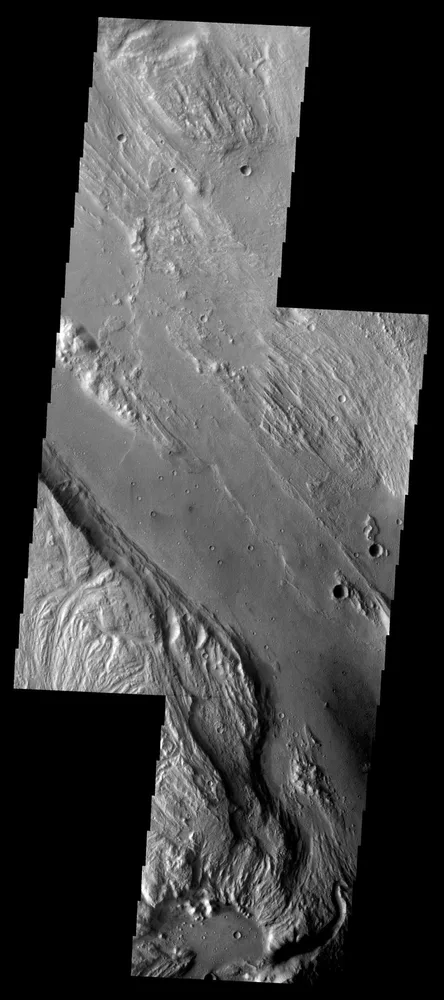
Ares Vallis
Image: NASA/JPL/Arizona State University · PIA06830 · NASA sourceOverview
Ares Vallis stands as a monument to Mars' catastrophically violent water-dominated past, serving as the historic landing site for NASA's groundbreaking Mars Pathfinder mission and humanity's first successful Mars rover, Sojourner. This massive ancient flood channel, named after Ares, the Greek god of war, stretches over 1,757 kilometers across the Martian landscape, carved by some of the largest floods ever recorded in the solar system.
The flood plains of Ares Vallis tell the story of catastrophic water release events that occurred billions of years ago when Mars had a thicker atmosphere and warmer climate. These massive floods transported rocks from diverse regions across Mars, creating a natural rock collection that provided scientists with their first detailed analysis of Martian geology from the surface.
The successful Pathfinder mission in 1997 not only marked humanity's return to the Martian surface after the Viking missions but also demonstrated innovative landing technologies and proved that relatively low-cost missions could achieve groundbreaking scientific discoveries, paving the way for all subsequent Mars exploration.
Quick Facts
Mars Pathfinder: Pioneering Modern Mars Exploration
Launched on December 4, 1996, Mars Pathfinder revolutionized Mars exploration by demonstrating that innovative, cost-effective missions could achieve remarkable scientific results. The mission landed in Ares Vallis on July 4, 1997, using a pioneering airbag landing system that allowed the spacecraft to bounce to a safe landing on the rocky terrain.
Mission Innovations
- • First airbag landing system on Mars
- • Cost-effective "faster, better, cheaper" approach
- • Real-time internet coverage of landing
- • Deployed first successful Mars rover
Scientific Objectives
- • Characterize Martian rocks and soil
- • Study atmospheric conditions
- • Test mobile rover technology
- • Analyze flood deposit geology
Sojourner Rover Achievements
The 23-pound Sojourner rover, originally designed for a 7-day mission, operated successfully for 12 weeks, far exceeding expectations. This pioneering rover analyzed 16 different rocks using its Alpha Proton X-ray Spectrometer (APXS) and took over 550 images of the Martian landscape.
Sojourner's success proved that robotic exploration could provide detailed scientific analysis while being mobile enough to investigate multiple targets, establishing the foundation for all future Mars rover missions including Spirit, Opportunity, Curiosity, and Perseverance.
Catastrophic Flood Channel: Ancient Water's Violent Past
Formation by Megafloods
Ares Vallis was carved by catastrophic floods that rivaled or exceeded the largest floods known on Earth. These massive water releases occurred when underground aquifers burst forth, creating flood volumes that could have filled the Mediterranean Sea in a matter of days.
The floods originated from chaotic terrain regions far to the south, where massive groundwater release events carved the distinctive channels that flow through Xanthe Terra highlands before ending in the Chryse Planitia delta region.
Rock Transport and Deposition
The catastrophic floods transported rocks from diverse geological regions across hundreds of kilometers, creating a natural "rock collection" in the Ares Vallis flood plains. This transport process deposited rocks with different compositions and histories in a single location.
The flood deposits include everything from ancient crater materials to volcanic rocks, providing a unique opportunity to study Mars' geological diversity without traveling vast distances across the planet's surface.
Scale and Timing of Ancient Floods
The floods that carved Ares Vallis occurred during Mars' early history when the planet had a thicker atmosphere and warmer climate conditions. These events represent some of the most dramatic water-related geological processes ever documented in the solar system, with flow rates that may have exceeded 10 million cubic meters per second.
The timing of these floods corresponds to a period when Mars was transitioning from its early, more Earth-like conditions to the cold, arid planet we observe today, making Ares Vallis a crucial record of this dramatic climate change.
Groundbreaking Rock Analysis and Water Evidence
"Barnacle Bill" and Andesitic Composition
Sojourner's analysis of "Barnacle Bill," the first rock studied on Mars, revealed an andesitic composition with higher silica content than expected. This discovery was significant because andesites typically form through complex geological processes involving crust-mantle interactions.
The presence of andesitic rocks suggested that early Mars had more complex geological processes than previously thought, including potentially active plate tectonics or extensive crustal recycling processes that concentrated silica-rich materials.
Water-Worked Conglomerates
The most exciting discoveries were rounded pebbles and conglomerate rocks that clearly showed evidence of water transport and deposition. These features indicated that liquid water had flowed through the region, rounding and cementing different rock types together.
The presence of these water-worked features provided direct evidence for Mars' wetter past and supported theories about catastrophic flooding events. The conglomerates showed that water persisted long enough to perform significant geological work.
Diverse Rock Collection Analysis
Sojourner analyzed 16 different rocks during its extended mission, revealing a remarkable diversity of compositions that told the story of Mars' geological evolution. The rocks ranged from basaltic volcanic materials to more evolved silica-rich compositions, indicating complex magmatic processes.
Volcanic Rocks
Basaltic to andesitic compositions indicating diverse magmatic processes
Sedimentary Features
Rounded pebbles and conglomerate rocks from water transport
Impact Materials
Rocks likely derived from ancient impact crater formations
Modern Understanding and Recent Insights
Enhanced Orbital Perspectives (2024)
Recent high-resolution imagery and analysis continue to reveal new details about the ancient flood processes that shaped Ares Vallis. ESA's Mars Express mission has provided detailed fly-around perspectives showing the dramatic scale of the ancient flooding.
The 2024 imagery reveals that the flood channels extend even further than originally mapped, with evidence for multiple flood episodes that occurred over extended periods, suggesting that water activity in this region was more sustained than initially thought.
Comparative Planetary Geology
Studies of Ares Vallis have become crucial for understanding catastrophic flooding processes throughout the solar system. The channel's features are now used as analogs for similar processes on other planets and moons where water or other fluids may have carved surface features.
The geological processes documented at Ares Vallis help scientists understand how catastrophic fluid release events can rapidly reshape planetary surfaces, providing insights relevant to astrobiology and planetary evolution studies.
Climate Evolution Implications
Modern analysis of Pathfinder data, combined with results from subsequent missions, has refined our understanding of Mars' climate evolution. The evidence from Ares Vallis supports models suggesting that early Mars experienced episodic warm periods when large volumes of liquid water could flow across the surface.
The geological record preserved in Ares Vallis indicates that these warm, wet periods may have been relatively brief in geological terms but intense enough to carve massive channel systems and transport enormous volumes of rock and sediment across the planet.
Terraforming Assessment
Moderate Terraforming Potential
Diverse geological resources and historical significance
Advantages
- • Diverse rock samples from across Mars
- • Proven ancient water flow evidence
- • Relatively flat terrain for construction
- • Extensive geological diversity
- • Historical significance for Mars exploration
- • Well-characterized landing site
- • Access to flood channel deposits
Challenges
- • Limited current water resources
- • Ancient age of water activity
- • Dust accumulation issues
- • Radiation exposure on open plains
- • Distance from polar ice caps
- • Moderate elevation with temperature extremes
- • Limited subsurface resource data
Scientific Legacy and Impact
Foundation of Modern Mars Exploration
The Mars Pathfinder mission at Ares Vallis established the template for all subsequent Mars exploration. Its innovative landing system, cost-effective approach, and successful rover deployment proved that ambitious scientific objectives could be achieved with relatively modest budgets, leading to the golden age of Mars exploration.
Water Activity Evidence
Ares Vallis provided some of the first definitive surface evidence for ancient water activity on Mars through analysis of rounded pebbles and conglomerate rocks. This evidence helped establish the scientific foundation for understanding Mars as a planet that once had conditions potentially suitable for life.
Geological Diversity Insights
The diverse collection of rocks deposited by ancient floods in Ares Vallis provided scientists with insights into Mars' geological complexity that would have required multiple landing sites to obtain otherwise. This "natural rock collection" revealed the planet's varied geological processes and compositional evolution.
Future Research Opportunities
While Ares Vallis has been extensively studied since the Pathfinder mission, modern analytical techniques and advanced rover capabilities could reveal new insights about this historically significant location. The channel system continues to be an important target for understanding Mars' hydrological history and climate evolution.
Advanced Analysis Opportunities
- • High-resolution mineralogical mapping
- • Subsurface water/ice resource assessment
- • Advanced organic compound detection
- • Detailed flood chronology studies
- • Comparative analysis with other flood channels
Historical Preservation Value
- • Pathfinder landing site preservation
- • Educational and inspirational significance
- • Comparison with modern rover capabilities
- • Benchmark location for technological advancement
- • Cultural heritage site for space exploration