Arcadia Planitia
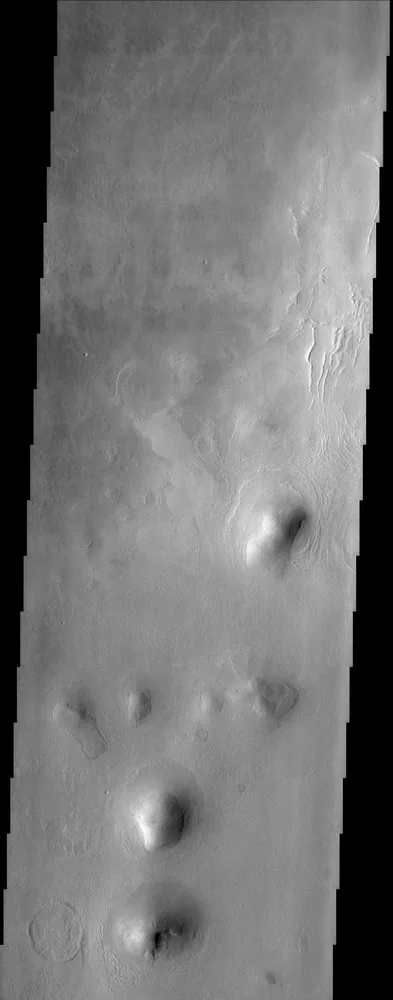
Arcadia Planitia
Image: NASA/JPL/Arizona State University · PIA04059 · NASA sourceOverview
Arcadia Planitia represents one of Mars' most promising locations for future human settlements and In-Situ Resource Utilization (ISRU). This vast northern plains region, centered at approximately 47°N, 184°E, contains abundant shallow subsurface water ice deposits that could support astronaut life support and fuel production needs.
The Subsurface Water Ice Mapping (SWIM) project has identified Arcadia Planitia as having ice deposits less than 30 centimeters below the surface, making it exceptionally accessible for drilling and extraction operations. These ice deposits represent some of the most accessible water resources discovered on Mars, with an estimated volume that could support multiple human missions.
Recent research has revealed that these ice deposits are tens of millions of years old, indicating remarkable preservation in the Martian environment. The region's geological stability and abundant water resources make it a top candidate for NASA's future Mars exploration missions.
Quick Facts
Shallow Subsurface Ice Deposits
Arcadia Planitia contains some of the most accessible water ice deposits on Mars, with SWIM mapping data revealing ice at depths of less than 30 centimeters below the surface. This shallow depth makes it ideal for robotic and human-operated drilling systems that could extract water for life support, rocket fuel production, and other ISRU applications.
Ice Characteristics
- • Depth: Less than 30 cm from surface
- • Distribution: Widespread across region
- • Purity: High ice content confirmed
- • Age: Tens of millions of years old
- • Preservation: Excellent in current climate
ISRU Applications
- • Drinking water production
- • Oxygen generation for life support
- • Hydrogen fuel for return missions
- • Agricultural water supply
- • Radiation shielding material
Scientific Evidence and Research
Expanded Secondary Craters
Thermokarstically expanded secondary craters throughout Arcadia Planitia provide evidence of extensive subsurface ice. These craters form when impact events destabilize buried ice layers, causing sublimation and ground collapse.
The distribution of these features indicates ice deposits extend to fairly low latitudes, with some evidence found below 40°N latitude.
Glacial-Related Features
Researchers have identified and mapped glacial features reminiscent of lineated valley fill and lobate debris aprons in Arcadia Planitia. These features show surface morphologies and spectral properties indicative of massive buried ice.
Distinct boundaries, arcuate banding, and deep radar reflections confirm substantial ice preservation beneath protective debris layers.
Water Volume Estimates
Scientific estimates suggest Arcadia Planitia could contain 3.5-16 million cubic kilometers of subsurface water, equivalent to a 24-110 meter global equivalent layer. Even accounting for sublimation losses, at least 6,000 cubic kilometers of ice likely remains preserved beneath uncratered regions.
Advanced orbital radar observations from the Mars Reconnaissance Orbiter's SHARAD instrument have been crucial in constraining the dielectric properties and composition of these ice-rich materials.
ISRU and Mission Planning
Prime ISRU Target Site
Optimal for water extraction and fuel production
Mission Advantages
- • Extremely shallow ice depth (< 30 cm)
- • Reduced drilling requirements
- • Lower energy extraction costs
- • Safe landing zone characteristics
- • Abundant resource distribution
- • Proven geological stability
Technical Considerations
- • Simple drilling technology required
- • Minimal excavation infrastructure
- • High water yield potential
- • Reduced contamination risk
- • Scalable extraction operations
- • Multiple landing site options
Terraforming Assessment
Excellent Terraforming Potential
Outstanding water resources and accessibility
Advantages
- • Abundant shallow subsurface ice
- • Prime ISRU capabilities
- • Excellent water resource access
- • Minimal drilling requirements
- • Stable geological environment
- • Proven ice preservation
- • Large resource distribution area
Challenges
- • High latitude cold temperatures
- • Limited solar energy availability
- • Seasonal temperature variations
- • Dust accumulation concerns
- • Radiation exposure at surface
- • Long polar winter periods
Future Exploration Opportunities
Arcadia Planitia is positioned to be a cornerstone location for Mars exploration and settlement. Its exceptional ice accessibility makes it an ideal testbed for ISRU technologies and a prime candidate for early human missions focused on resource utilization.
Priority Investigations
- • Ice composition and purity analysis
- • Drilling technology demonstrations
- • ISRU system validation
- • Landing site safety assessment
- • Resource distribution mapping
- • Climate stability monitoring
Mission Applications
- • Human precursor missions
- • ISRU technology validation
- • Water production systems
- • Fuel manufacturing facilities
- • Long-term settlement sites
- • Research base locations