Arabia Terra
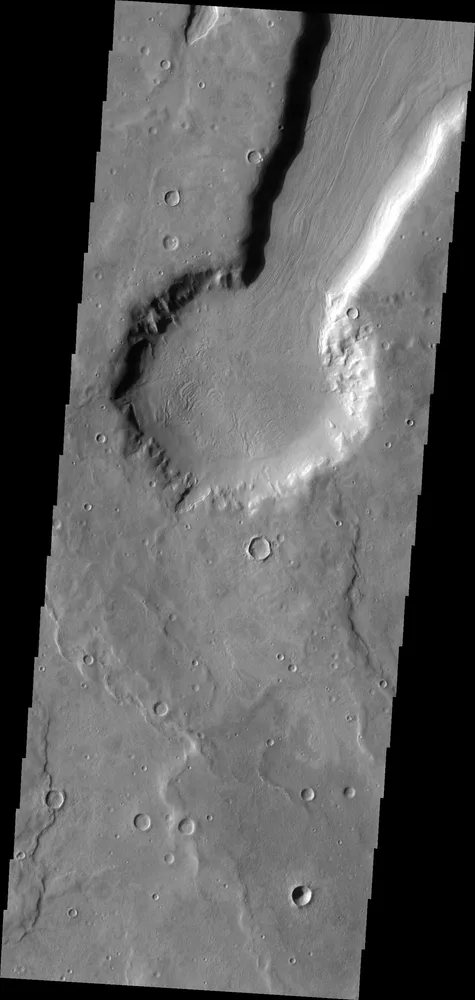
Arabia Terra
Image: NASA/JPL/ASU · PIA10866 · NASA sourceOverview
Arabia Terra represents one of Mars' most ancient and geologically significant highland regions, harboring evidence of massive supervolcanic eruptions that fundamentally shaped the planet's early history. This expansive terrain, covering thousands of square kilometers, preserves a record of explosive volcanism that rivals Earth's most catastrophic volcanic events.
Recent discoveries have revealed that Arabia Terra experienced thousands of "super eruptions" over a 500-million-year period approximately 4 billion years ago. These massive volcanic events expelled the equivalent of 400 million Olympic-sized swimming pools of molten rock and gas, creating calderas and fundamentally altering Mars' early climate and geological evolution.
The region is characterized by abundant clay-bearing rocks, evidence of ancient hydrothermal activity, and numerous calderas that were previously misidentified as impact craters. This treasure trove of geological diversity makes Arabia Terra a prime target for understanding Mars' transition from a potentially habitable world to its current state.
Quick Facts
Supervolcano Calderas: A Geological Revolution
What were once thought to be ancient impact craters have been revealed as massive volcanic calderas formed by supervolcanic eruptions. These calderas collapsed inward after explosive eruptions emptied underground magma chambers, creating the distinctive basin-like features we observe today.
Caldera Characteristics
Seven major calderas have been identified, each representing collapsed volcanic structures similar to terrestrial supervolcanoes like Yellowstone. These low-relief features possess complex topographic depressions with evidence of structural collapse, effusive volcanism, and explosive eruptions.
Eruption Scale
The scale of volcanic activity was enormous, with individual eruptions capable of degassing approximately 100 million kilograms of sulfur compounds into the atmosphere. These eruptions would have had profound climate-altering effects on early Mars.
500 Million Years of Explosive Volcanism
Thousands of Super Eruptions
Arabia Terra experienced thousands of supervolcanic eruptions during a 500-million-year period around 4 billion years ago. These eruptions expelled massive volumes of water vapor, carbon dioxide, and sulfur dioxide into the atmosphere, fundamentally altering Mars' early climate.
Each super eruption was capable of blasting hundreds of millions of tons of molten rock and gas through the surface, spreading thick blankets of ash across thousands of miles and leaving behind massive calderas when the volcanic structures collapsed.
Climate and Atmospheric Impact
The massive scale of volcanic outgassing from Arabia Terra's supervolcanoes would have dramatically altered Mars' early atmosphere and climate. The eruptions injected enormous quantities of sulfur compounds, water vapor, and other gases that could have supported a thicker atmosphere and potentially warmer surface conditions.
However, these same eruptions may have also contributed to atmospheric loss over time, as the massive dust clouds and chemical changes could have triggered cooling events and atmospheric escape processes that gradually transformed Mars into the cold, dry world we see today.
Preserved Volcanic Evidence
The geological evidence for Arabia Terra's supervolcanic past is remarkably well preserved in the mineral composition and layered deposits throughout the region. Recent analysis has revealed that the volcanic ash layers remain intact and clearly stratified, providing a detailed record of individual eruption events.
Mineral Evidence
Clay-bearing rocks throughout Arabia Terra show evidence of hydrothermal alteration from volcanic processes and water interaction.
Ash Layer Preservation
Well-preserved ash layers show clear stratification without wind or water mixing, indicating rapid deposition and burial.
Pyroclastic Deposits
Low-density pyroclastic deposits detected through gravitational modeling support explosive volcanic origin theories.
Research Techniques
Early Mars Habitability Implications
Hydrothermal Systems
The massive volcanic activity in Arabia Terra would have created extensive hydrothermal systems - environments where heated water interacts with rock, potentially creating conditions suitable for early life. The clay-bearing rocks throughout the region provide evidence of these water-rock interactions.
Hydrothermal environments are considered some of the most promising locations for early life on Earth, and similar conditions in Arabia Terra may have provided habitable niches during Mars' early history.
Atmospheric Evolution
The supervolcanic eruptions contributed to Mars' atmospheric evolution by releasing massive amounts of gases. While initially thickening the atmosphere and potentially warming the surface, the long-term effects may have contributed to atmospheric loss processes.
Understanding this volcanic influence is crucial for modeling Mars' transition from potentially habitable conditions to its current state.
Terraforming Assessment
Good Terraforming Potential
Rich mineral resources and geological diversity
Advantages
- • Abundant clay-bearing rocks for construction
- • Evidence of past hydrothermal systems
- • Diverse mineral resources from volcanic activity
- • Ancient highland elevation advantages
- • Rich geological record for resource mapping
- • Potential geothermal energy sources
Challenges
- • Limited current water resources
- • Dust accumulation in highland terrain
- • Ancient surface with impact crater hazards
- • Radiation exposure concerns
- • Temperature variations at elevation
- • Complex terrain navigation
Scientific Significance
Planetary Evolution Archive
Arabia Terra serves as a natural laboratory for understanding how massive volcanism can shape planetary evolution. The preserved record of 500 million years of supervolcanic activity provides unprecedented insights into early Mars' geological processes and their role in atmospheric and climate evolution.
Comparative Planetology
The scale of volcanic activity preserved in Arabia Terra exceeds anything seen on Earth, making it crucial for understanding how extreme volcanism affects planetary habitability. This research informs our understanding of volcanic processes on other worlds and the role of volcanism in planetary evolution throughout the solar system.
Future Exploration Opportunities
Arabia Terra represents a high-priority target for future Mars exploration due to its unique geological history and potential for understanding early Martian habitability. The region's diverse mineral assemblages and well-preserved volcanic record make it ideal for both robotic and eventually human exploration.
Priority Research Goals
- • Detailed caldera floor exploration
- • Hydrothermal deposit analysis
- • Ancient volcanic ash sampling
- • Clay mineral characterization
- • Astrobiology investigations
Resource Potential
- • Clay minerals for construction materials
- • Volcanic glass for manufacturing
- • Hydrothermal mineral deposits
- • Potential geothermal energy sites
- • Water-altered rock resources